Workplace Smoking Shelters: What UK Employers Need to Know

Alex Thomas
Managing Director
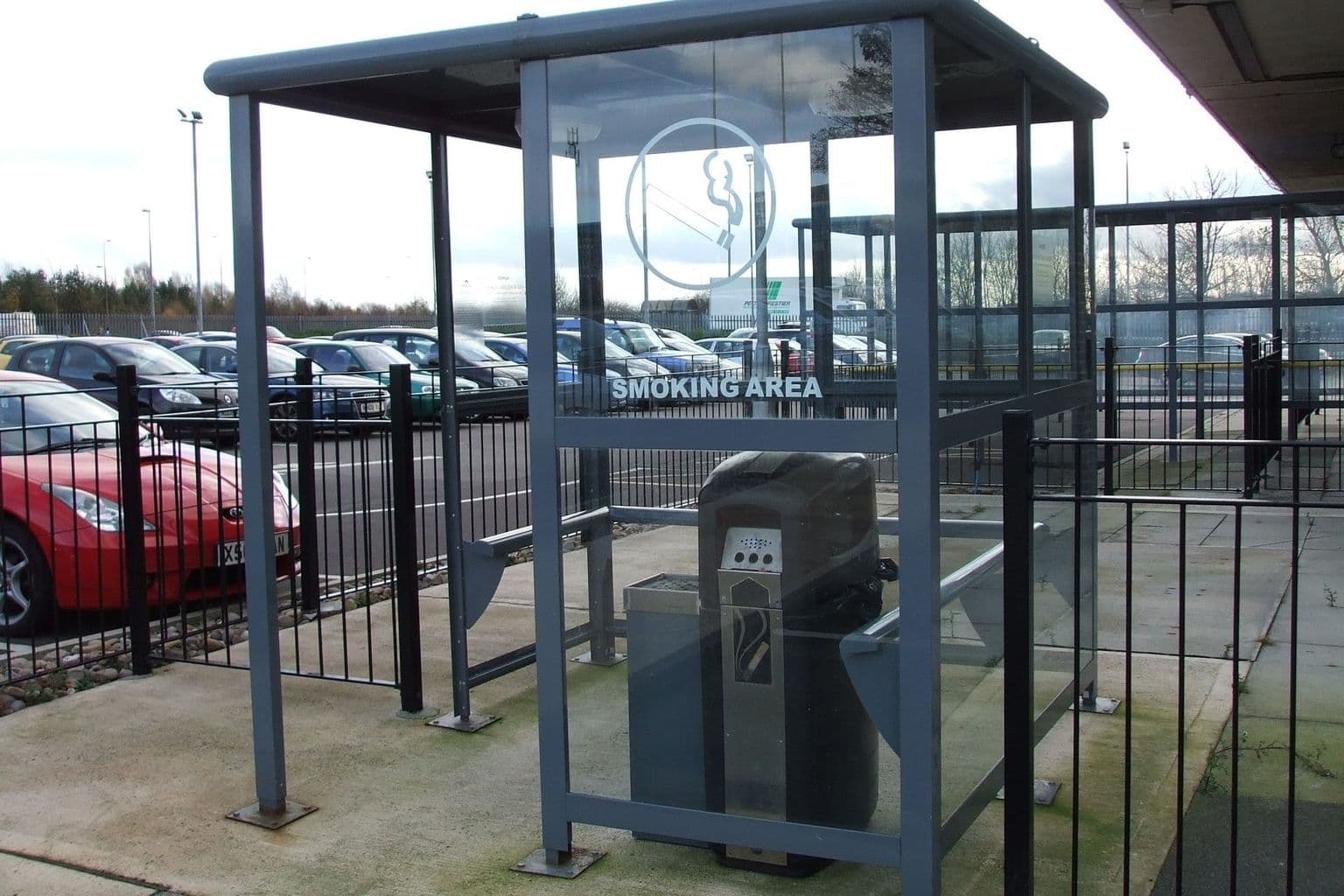
Most of the smoking shelter enquiries we get from offices, factories and distribution sites start the same way. Staff are smoking by the main door, someone has complained, and the facilities or HR manager has been asked to "sort out a proper smoking area."
That is a sensible thing to do. But it helps to know what the law actually asks of you before you choose a shelter or a spot to put it.
The short answer
You do not have to provide a smoking area. There is no legal duty on an employer to give staff anywhere to smoke.
What you do have to do is keep your premises smoke-free. If you choose to provide a shelter, it must not be "substantially enclosed", and it should be sited so that smoke does not drift back into the building.
What the law requires of employers
The Health Act 2006 made enclosed and substantially enclosed workplaces smoke-free in England and Wales from July 2007. Scotland and Northern Ireland have equivalent laws. Enforcement is by your local authority, usually through environmental health officers.
In practice, three things fall to you as the employer or the person in control of the premises:
- Stop people smoking inside. That includes offices, warehouses, canteens, toilets, and company vehicles used by more than one person.
- Display no-smoking signs. Smoke-free premises in England must display at least one legible no-smoking sign. Most employers put one at each entrance.
- Keep any shelter legal. A smoking shelter is still part of your premises. If it is substantially enclosed, smoking in it is illegal, and both the smoker and the person in control of the premises can be fined.
The 50% rule in plain terms
A structure is substantially enclosed if it has a roof and the openings in its walls add up to less than half of the total wall area.
So a shelter with a roof and a solid back wall, with the front and both sides open, is fine. A shelter with three solid walls and an open front is not, however much air seems to get in. The roof does not count in the calculation. Only the walls do.
We cover the calculation in detail, with worked examples, in our smoking shelter regulations guide. If you are weighing up shapes, Canopy, Three-Sided or Enclosed? compares them side by side.
What about vaping?
The smoke-free law covers tobacco smoke. It does not cover e-cigarettes.
That means whether staff can vape indoors, outside, or in the smoking shelter is up to your own workplace policy. Many employers keep vaping out of the building but separate from the smoking shelter, so people trying to quit are not standing in other people's smoke. Whatever you decide, write it down and tell staff, so the rule is the same on every shift.
Where to put a staff smoking shelter
This is where most workplace shelters go wrong. A shelter that is too far away does not get used, and staff go back to the door. A shelter that is too close lets smoke back into the building.
Away from doors, windows and air intakes. The Act sets no fixed distance, but most environmental health officers treat 3 metres as a reasonable minimum, and we recommend 5 metres where the site allows. Check where your building's ventilation intakes are, not just the doors. See How Far From a Building Does a Smoking Shelter Need to Be? for more.
Not on a fire escape route. The shelter must not block a fire exit, an assembly point or emergency vehicle access. Ask whoever does your fire risk assessment to include the smoking area.
Not on the visitor route. If customers or visitors walk past the shelter to reach reception, it is in the wrong place. A side or rear elevation near the staff entrance usually works best.
On a sound, level surface. Most shelters bolt down to existing concrete or tarmac. A grass verge will need a base first.
Easy to reach in a short break. On a large site with a single shelter, staff on the far side will not walk to it. Two smaller shelters can work better than one large one.
Lit after dark. Shift workers use the shelter in the dark through the winter. Make sure it sits within existing external lighting, or add lighting to the shelter itself.
Sizing it for your workforce
Size the shelter for the busiest break, not the average. A shelter that fits four people will be overcrowded if eight staff share the same lunch break, and the overflow ends up by the door again.
Our smoking shelter buyer's guide covers sizes, materials and bases in more detail.
The details that make staff use it
A butt bin. Without one, the ground around the shelter fills with cigarette ends. A wall-mounted butt bin or integral ashtray costs little and saves on cleaning.
Seating. Perch seating is common on workplace sites. It gives people somewhere to lean without turning the shelter into a place to stay all afternoon.
A solid back wall facing the weather. One solid wall on the side of the prevailing wind makes the shelter far more usable without breaking the 50% rule.
Clear signage. A sign marking the smoking area helps keep smoking away from the doors, and a reminder of your vaping policy helps too.
Planning permission
Most workplace smoking shelters do not need planning permission, but some do. It depends on the size, the position and the site. Listed buildings and conservation areas need more care. See Does a Smoking Shelter Need Planning Permission? before you order.
What it costs
A small workplace shelter is a modest outlay compared with the time lost to staff walking off site, or to cleaning up the main entrance every morning. For typical prices by size and configuration, read How Much Does a Smoking Shelter Cost?
What to send us
- A photo or site plan showing where you would like the shelter
- Roughly how many people use it at the busiest break
- What the ground is: concrete, tarmac, paving or grass
- Whether it will be freestanding or fixed to a wall
- Any extras: seating, butt bins, lighting, a sign panel
We have manufactured outdoor shelters since 1994. I have been Managing Director since 2021. We will tell you if the design you have in mind falls foul of the 50% rule before you buy it, not after.
View smoking shelters or call 01704 547 321. If you would rather start on the form, request a quote.
Managing Director, Alotek Shelters Ltd
About Alex Thomas
Managing Director of Alotek Shelters since 2021. Trained in CAD and design at Southampton Solent University (BSc, 2:1). Design, fabricate and install from the Lancashire workshop.