What to Ask Before Buying a Smoking Shelter: 8 Questions Most Businesses Skip
Alex Thomas
Founder & Director
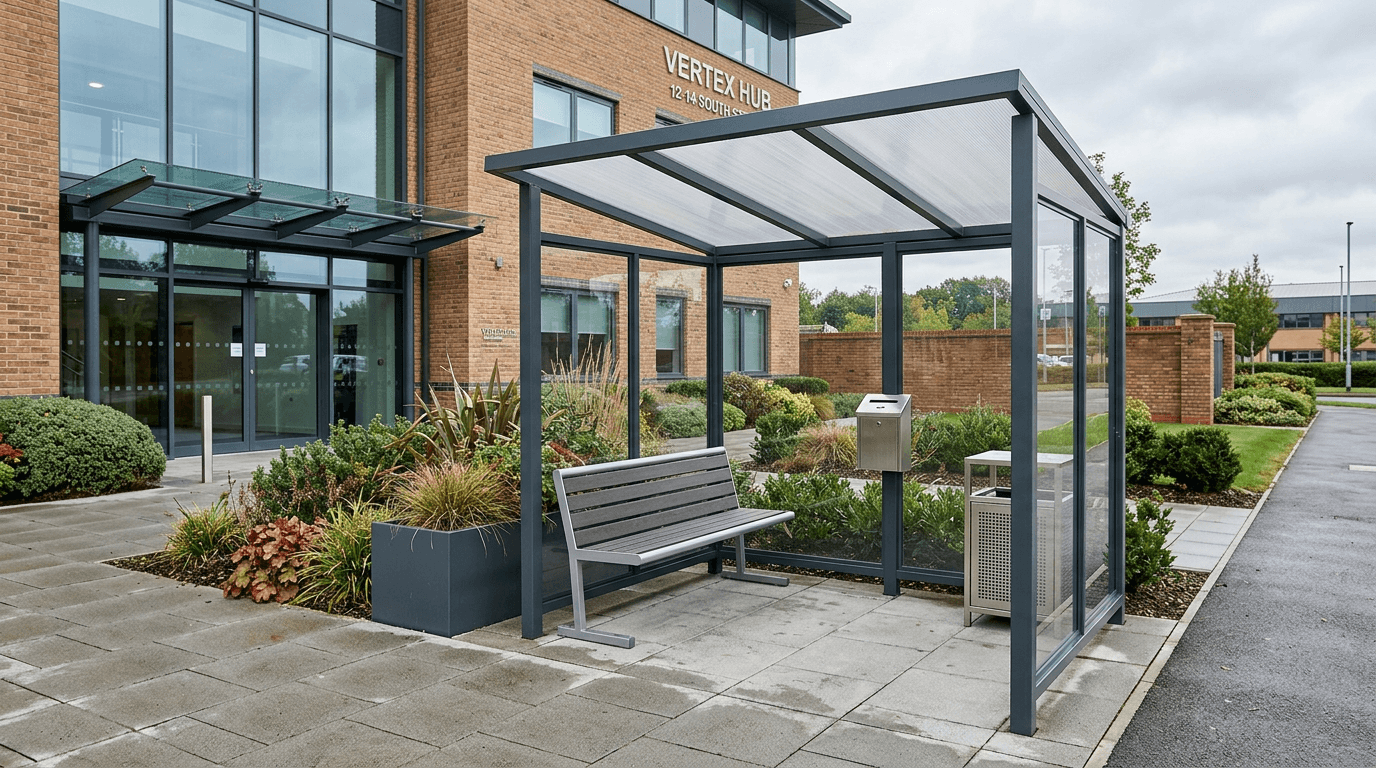
Smoking shelters are probably the least glamorous product we make. Nobody's excited about a smoking shelter the way they are about a covered walkway or a new school canopy. They're a practical necessity, they need to comply with legislation, and most businesses just want the problem solved with minimum fuss.
Which is exactly why so many businesses get it wrong.
I've seen shelters fail compliance checks on the day of installation. I've seen cheap steel units rust through in 18 months. I've seen perfectly good shelters sited in the wrong place and become a disciplinary issue.
Here are the eight questions you should ask before buying any smoking shelter for your business.
1. Does It Meet the 50% Open Sides Requirement?
This is the legal baseline and you'd be surprised how many shelters sold as "compliant" are anything but.
The Health Act 2006 requires that any shelter designated as a smoking area must be substantially open, meaning at least 50% of the total wall area must be open to the atmosphere. A shelter that's fully enclosed on three sides and open only at the front does not meet this requirement.
The maths: add up all four wall areas (including any roof-height walls). At least half of that total must be open air, not glazed, not mesh, not any other material.
Before you buy anything, ask the supplier to confirm in writing that the design meets the 50% open sides requirement. If they hesitate or say "it should be fine," keep looking.
2. How Far From a Doorway or Window Does It Need to Be?
The Health Act doesn't specify a minimum distance in law, but your employer's duty of care under health and safety legislation means smoke shouldn't drift back into the building through doors or windows.
In practice, most environmental health officers use 3 metres as a reasonable minimum distance from any doorway or openable window. We recommend 5 metres where site layout allows.
Before you decide where your shelter goes, check:
- Which doors are used most by non-smokers?
- Where are air intake vents for the building's ventilation system?
- Where do customers or the public typically enter?
Putting a shelter in the wrong place is a siting problem you'll have to solve again later. Get it right first time.
3. Do You Need Planning Permission?
Probably not, but worth checking.
Most smoking shelters fall under permitted development rights for commercial premises, so you don't need planning permission. However, there are exceptions:
- Listed buildings
- Conservation areas
- Premises within a national park or area of outstanding natural beauty
- Any structure over a certain height or footprint (thresholds vary by local authority)
A quick call to your local planning authority before you order takes five minutes and saves potential enforcement headaches later.
4. What Material Is the Frame Made From?
This is where cheap shelters get you.
Steel (painted or powder coated): Cheaper upfront. Will rust where the coating chips or weathers, typically starting at joints and fixings. In coastal or urban environments with road salt, you can see visible rust within 12 to 18 months of installation.
Aluminium: More expensive upfront, no maintenance, no rust, no repainting. Over a five-year period, aluminium shelters are almost always cheaper than steel once you factor in maintenance costs.
For most businesses, aluminium is the right choice. Steel makes sense only if budget is extremely tight and you're in a sheltered inland location with genuinely dry conditions.
5. What Is the Roof Material?
The roof is what protects your employees, so take it seriously.
Polycarbonate: The most common option. Lightweight, available in clear or tinted. Tends to yellow and scratch over time, usually visible after three to five years. Fine for lower-traffic or less visible locations.
Toughened glass: Heavier, more expensive, looks better for longer. Doesn't discolour. The premium is worth it for any shelter in a customer-facing location (hotel entrances, office building frontages, hospitality venues).
Solid aluminium roof panels: Some businesses prefer a solid roof for complete overhead weather protection. Good for exposed sites. No natural light under the shelter, which some users dislike.
6. Is There a Concrete Base Included?
Here's one that catches people out.
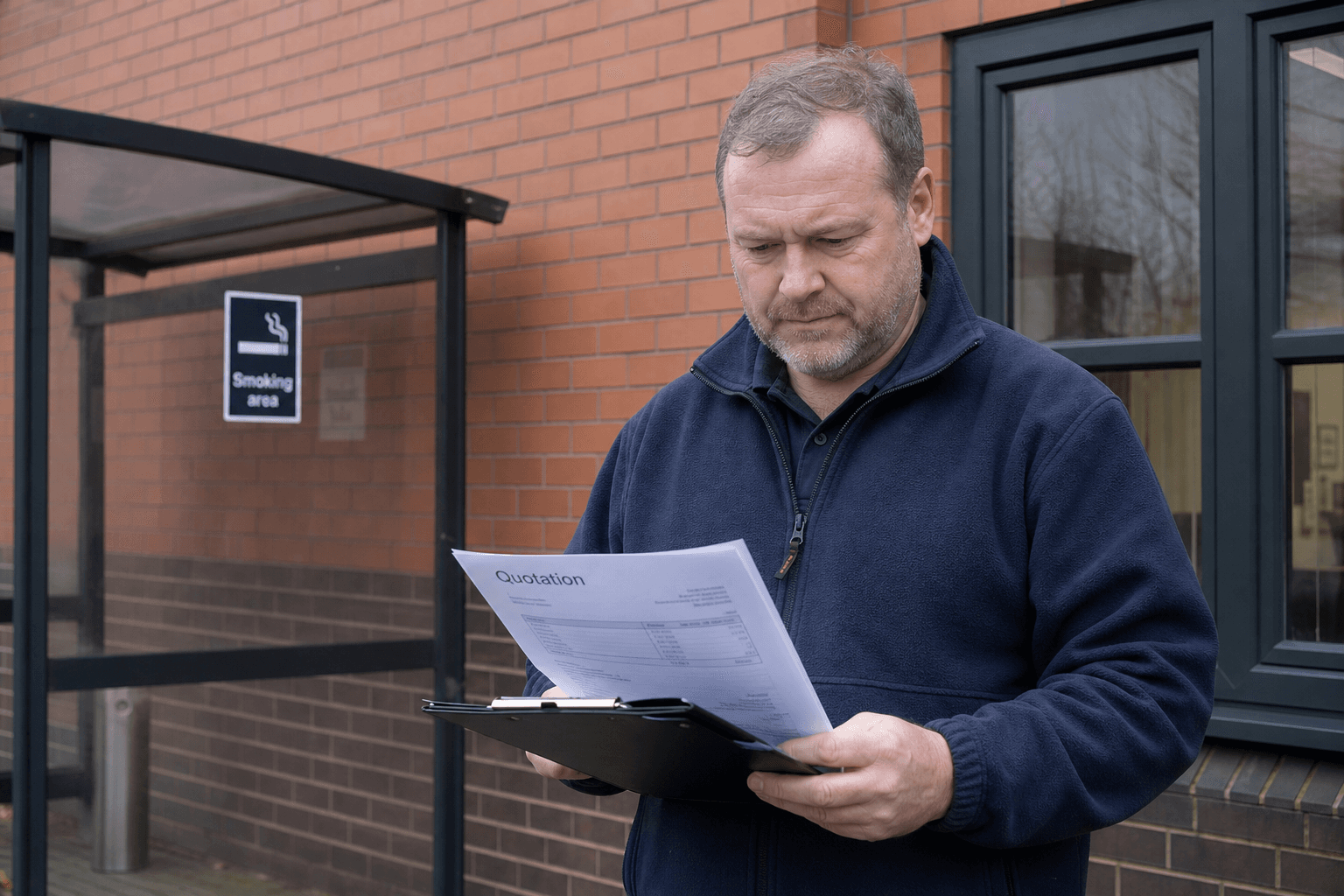
Most smoking shelter quotes are for the structure only. The base, whether that's a concrete foundation slab, paving, or anchoring to existing hard standing, is often a separate cost.
Ask the supplier:
- Is the base included in the price?
- If not, what do I need to provide?
- What are the fixing requirements?
A shelter without proper foundations will shift, settle, and look sloppy within a year. Get the base sorted as part of the same project.
7. What About Seating and Ashtrays?
Standard commercial shelters usually come without seating as a default. You'll need to specify:
- Do you want fixed bench seating? (Adds £150 to £400 typically.)
- Do you want a wall-mounted ashtray with bracket? (Usually £50 to £150.)
- Do you want perch seating rather than full benches to discourage lingering?
Think about your environment. A hotel or upmarket office might want better seating and a more considered finish. A warehouse loading dock just needs something functional.
Also worth considering: provision for waste. Butts on the ground outside a smoking shelter are a cleaning issue and look poor. A wall-mounted butt bin or integral ashtray is a small cost that makes a real difference.
8. Who Is Installing It and Are They Insured?
This sounds obvious, but I've seen businesses accept deliveries from suppliers who expect the business to arrange installation themselves, using in-house maintenance staff.
A smoking shelter needs to be properly anchored. An improperly installed shelter in a high-wind event is a liability issue. Make sure:
- Your supplier or installer carries appropriate public liability insurance.
- Installation is done by a qualified contractor, not someone from the maintenance team with a drill.
- You get a completion certificate or installation report you can keep on file.
We provide full installation as standard on all shelters and issue documentation on completion.
What a Good Smoking Shelter Should Cost
For a standard commercial aluminium smoking shelter, supplied and installed:
| Spec | Approx. Cost (exc. VAT) |
|---|---|
| Single bay, 2-3 person, polycarbonate roof | £1,800 to £3,000 |
| Double bay, 4-6 person, polycarbonate roof | £2,800 to £4,500 |
| Premium with glass roof and fixed seating | £4,000 to £7,000 |
These are ballpark figures. Actual cost depends on your site, access, base requirements, and specification. But they'll tell you quickly whether a quote you've received is realistic or suspiciously cheap.
Getting It Right First Time
The businesses that get caught out with smoking shelters are usually the ones that left it to the last minute and went for the cheapest option available online. I understand the instinct, but the cost of getting it wrong, whether that's a compliance issue, early replacement, or ongoing maintenance, adds up quickly.
If you want a straight answer on what's right for your site, give us a call on 01704 547 321. We'll tell you what you need, what it costs, and how quickly we can do it.
View our smoking shelters range or request a free quote. We work with businesses right across the UK, from London to Edinburgh, Manchester to Bristol.
About Alex Thomas
Founder of Alotek Shelters with 30+ years of experience in outdoor structures. Known for attention to detail and a relaxed, practical approach to problem-solving.
Get in touch →