Types of Smoking Shelter: Canopy, Three-Sided or Enclosed? Which is Right for Your Site

Alex Thomas
Managing Director
When a facilities manager or employer starts looking for a smoking shelter, they typically search for something that keeps their staff dry and looks reasonably tidy. What they often do not realise until later is that the configuration of the shelter determines whether it is legally compliant under the Health Act 2006. The wrong design is not just aesthetically poor. It means smoking inside it is illegal.
Here is the practical guide to the main configurations, what they provide, and which situations they suit.
The legal background in one paragraph
The Health Act 2006 bans smoking in premises that are substantially enclosed. Substantially enclosed means the total area of the wall openings is less than 50% of the total wall area. A shelter that is more than 50% enclosed is classed as an indoor space and smoking inside it is illegal. The roof does not count. Only the walls matter.
This shapes every configuration decision.
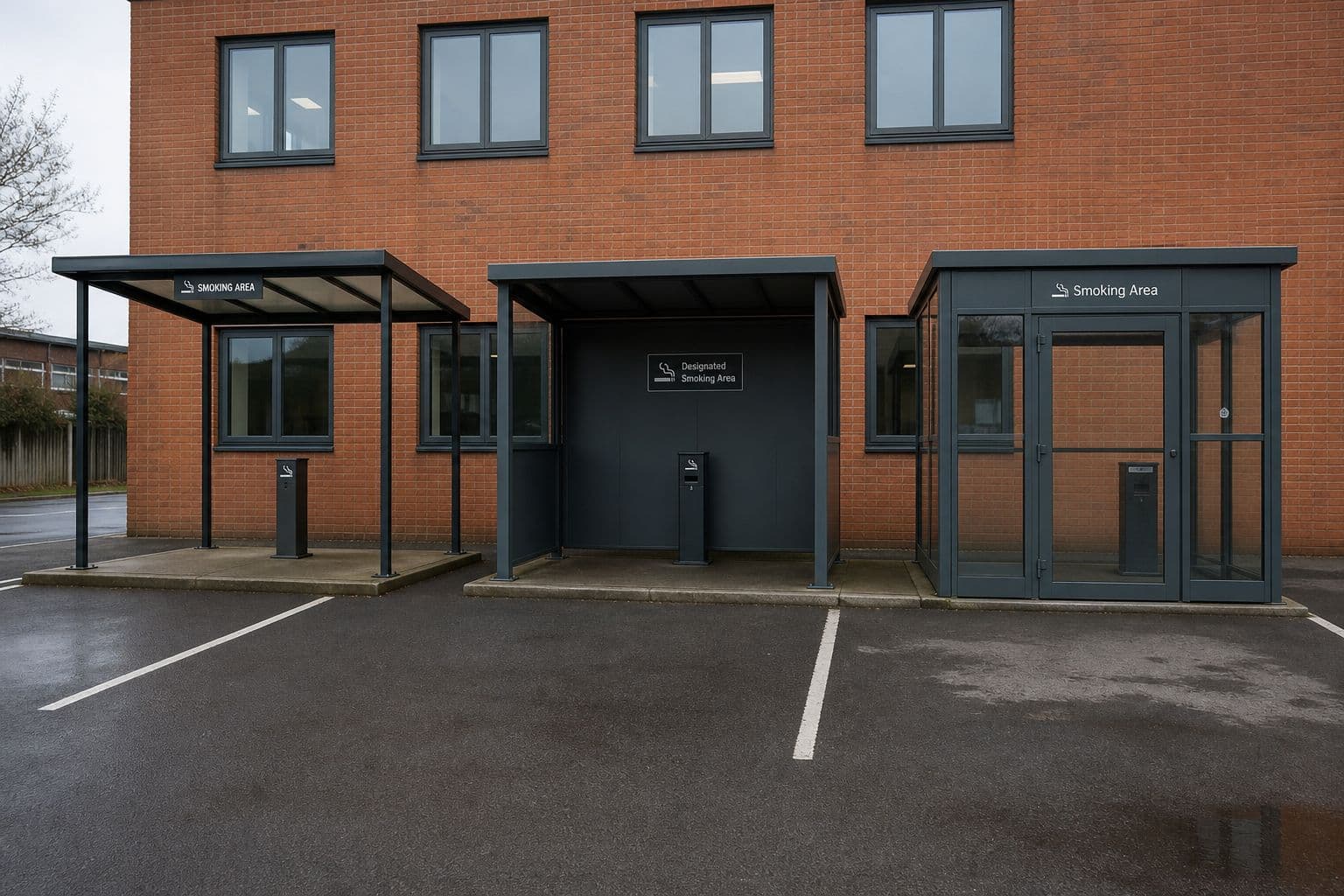
Configuration 1: Open canopy (no walls)
A flat or pitched roof structure on posts with no side panels at all. The simplest possible configuration.
Compliance: Fully compliant. Zero wall enclosure. There is no ambiguity.
Weather protection: Good overhead protection from rain and direct sun. Limited protection from wind-driven rain or cold. In an exposed location, people will stand under it in light rain but move away in a serious downpour with lateral wind.
Best for: Sheltered locations where the main need is rain protection from above, not wind protection from the sides. Buildings with a sheltered courtyard, south-facing walls blocking prevailing wind, or covered loading bays nearby. Also good anywhere the goal is maximum simplicity: nothing to clean behind, nothing to seal, nothing to go wrong.
Limitation: Offers the least weather comfort in a typical UK winter. Not suitable for exposed car parks or north-facing sites.
Configuration 2: Three-sided (solid back wall, two open sides)
A solid roof, a solid back wall facing the prevailing weather, and two fully open sides. The front is open. This is the most common compliant configuration for UK workplaces.
Compliance: Compliant. One solid wall out of four equals 25% enclosure. Well within the 50% rule.
Weather protection: Significantly better than an open canopy. The solid back wall blocks the prevailing wind. The open sides allow airflow and smoke dispersal. Comfortable for the person standing at the front under the roof, sheltered from both rain above and wind from behind.
Best for: The majority of UK commercial sites. Offices, warehouses, manufacturing premises, and most retail environments. The standard recommendation for anyone wanting the best balance of compliance and weather comfort.
Limitation: Less protection from cold in winter than a more enclosed configuration. If the back wall is not oriented to block the prevailing wind for your specific site, it provides less benefit than expected. Check which direction the wind typically comes from before positioning.
Configuration 3: Back wall and partial side screens
A solid roof, solid back wall, and polycarbonate or mesh screens on the two sides that do not run full height or full width. The screens provide wind protection while maintaining significant open area.
Compliance: Depends on the screen coverage. If the screens are half-height or have significant ventilation gaps, the open area may still exceed 50% of total wall area. This requires calculation. The safest approach is to get the supplier to confirm compliance for the specific configuration before purchase. Do not assume. Calculate.
Weather protection: The best of the compliant options. Wind protection from three directions without fully enclosing the shelter. The most comfortable option in winter.
Best for: Exposed sites, north-facing locations, high-footfall buildings where staff use the shelter frequently in all weathers. Worth the additional specification effort for sites where weather comfort is a genuine priority.
Limitation: Requires careful design to confirm compliance. Some configurations that look similar to this are actually non-compliant. Get written confirmation from the supplier.
Configuration 4: Three solid walls and one open side (non-compliant)
A solid roof, three solid walls, and a single open entrance at the front. This is the most common non-compliant configuration found at UK pubs, restaurants, and some workplaces. Three solid walls out of four equals 75% enclosure. The 50% rule is not met. Smoking inside it is technically illegal.
Compliance: Non-compliant. Do not specify this configuration.
Why it is so common: It provides the most weather protection of any shelter design and many buyers simply do not know the rule. It was often installed by suppliers who either did not check or did not advise correctly.
What to do if you already have one: You cannot make a three-walled shelter compliant without removing one of the solid wall panels. The fix is to replace one solid wall with an open bay or a partial screen. This is usually straightforward and can be done without replacing the whole structure.
A note on enclosed shelters
Fully enclosed shelters, with four solid walls, a roof and a door, are not smoking shelters under UK law. They are buildings. Smoking inside them is illegal. Any supplier selling a "smoking shelter" that is more than 50% enclosed is either uninformed or ignoring the law.
If a client or manager asks for something "more enclosed because it is warmer," the answer is that warmer and compliant are not mutually exclusive (Configuration 3 provides good warmth) but warmer and fully enclosed means you cannot legally smoke in it.
Which one should you choose?
| Your situation | Recommended configuration |
|---|---|
| Sheltered location, simple requirement | Open canopy |
| Standard UK office or commercial premises | Three-sided: back wall, two open sides |
| Exposed site, heavy use, winter comfort priority | Back wall with partial side screens (confirm compliance) |
| Pub or restaurant beer garden | Three-sided minimum. Open canopy if design suits. |
| NHS premises | Additional distance rules apply. Canopy or three-sided. Confirm 15m from building entrances. |
For the complete legal framework around smoking shelter rules in the UK, including the 50% open rule, planning permission, and employer duty of care, read: UK Smoking Shelter Regulations: What Employers and Venues Need to Know.
We manufacture aluminium smoking shelters in Lancashire in all compliant configurations. Every design we supply is confirmed compliant before manufacture. Call 01704 547 321 or visit our smoking shelters page for examples and a free quote.
Managing Director, Alotek Shelters Ltd
About Alex Thomas
Managing Director of Alotek Shelters since 2021. Trained in CAD and design at Southampton Solent University (BSc, 2:1). Design, fabricate and install from the Lancashire workshop.