Where to Put a Reverse Vending Machine Outside Your Store

Alex Thomas
Managing Director
When retailers ask us about a shelter for a reverse vending machine, the first question we ask back is where the machine is going. Quite often, nobody has decided yet.
That matters, because the position drives almost everything else: the shelter size, whether it can fix to the wall, how the machine gets power, and whether you need planning permission at all. With the Deposit Return Scheme launching on 1 October 2027, it is worth settling the position early, while there is still time to change it.
The short answer
The best position is usually against the front or side wall of the store, close to the entrance, on level ground, with power nearby and space behind or beside the machine for staff to empty it.
It should not block a fire exit, a pedestrian route, a delivery bay or an accessible parking space. It should be well lit and in view of staff or CCTV. And it needs to sit within the Class CA permitted development limits if you want to avoid a planning application.
Start with power and data
An RVM needs a mains power supply, and most machines also need a data connection to report returns. Your machine supplier will confirm the exact requirements for the model you are buying.
Running a new cable across a car park means trenching, reinstating the surface and more cost. A position against the store wall, close to an existing supply, is almost always cheaper and quicker. Get your electrician to look at the options before you fix the position.
Make it easy for customers to reach
Customers will be carrying bags, boxes and crates of empty bottles and cans. Some will bring them in a trolley. Some will be using a wheelchair, a walking frame or a pushchair.
Step-free. The route from the car park and the pavement to the machine should be level, with dropped kerbs where needed.
Near the entrance. People return containers on the way in to shop and spend the voucher at the till. A machine at the far end of the car park gets less use and more complaints.
Not in the main doorway. Customers at the machine take time. Keep them clear of the door so they are not standing in the way of people coming and going.
Room to queue under cover. A busy machine will have a queue. Our guide to RVM shelter size explains how much depth to allow in front of the machine.
Leave room for staff and collections
The machine has to be emptied, cleaned and restocked, and the full bags or bins have to go somewhere until they are collected.
Allow clear access behind or beside the machine for service, as set out in the size guide. Then think about the route from the machine to wherever full bags are stored, and from there to the collection vehicle. If staff have to drag heavy bags across a busy car park, or through the shop floor, the position needs another look.
Keep it clear of fire exits and vehicle routes
An RVM and its shelter must not obstruct a fire exit, an escape route or an assembly point. They must not block access for emergency vehicles either. Ask whoever carries out your fire risk assessment to look at the proposed position.
Keep the installation away from delivery bays and the swept path of delivery lorries. Do not take an accessible parking bay to make room for it. Where the machine is close to moving traffic, bollards or a kerb line will protect both the machine and the customers using it.
Lighting, visibility and security
People will use the machine in the dark for much of the year. A position under existing external lighting is cheaper than adding new lighting, though lighting can be built into the canopy if needed.
A machine in view of the shop windows or covered by CCTV is less likely to be damaged and feels safer to use. A tucked-away corner at the back of the building is the opposite.
Check the planning limits
Under the Class CA permitted development right, most outdoor RVM installations at shops in England do not need a planning application. The right has conditions. They include a maximum footprint, a maximum height, a minimum distance from residential land, and a limit on facing a highway when close to it. Listed buildings and some protected sites are excluded.
The residential distance is the one that most often affects the position on smaller sites. A convenience store with flats above or houses next door may find that only one side of the site works.
We explain every condition in Reverse Vending Machine Planning Permission: The Class CA Right Explained. Check the position against them before ordering anything.
Wall-mounted or freestanding?
If the machine sits against the store wall, a wall-mounted canopy is often the neatest answer. It uses the building for support and takes up less space.
If it has to go out in the car park, a freestanding canopy on base plates, with a solid back panel facing the weather, does the job. Either way, the canopy needs to cover the customer at the machine, not just the machine. Our reverse vending machine shelter guide covers the specification in full.
A quick checklist for your site
- Power and data within reach, or a clear route for new cables
- Level, step-free access from the car park and the pavement
- Close to the entrance but out of the main doorway
- Room for customers to queue under cover
- Service access behind or beside the machine
- A practical route for full bags to storage and collection
- Clear of fire exits, delivery bays and accessible parking
- Lit after dark and in view of staff or CCTV
- Within the Class CA conditions, or a planning application allowed for
What to send us
- The machine make and model, and how many machines
- A photo of the proposed spot and the shop front around it
- A rough site plan or aerial screenshot showing the entrance, parking and any homes nearby
- Whether the canopy can fix to the wall, or needs to be freestanding
- The date you need it installed
We have manufactured outdoor shelters since 1994. I have been Managing Director since 2021. We do not sell an off-the-shelf RVM shelter. We design an aluminium canopy around your machine and your site.
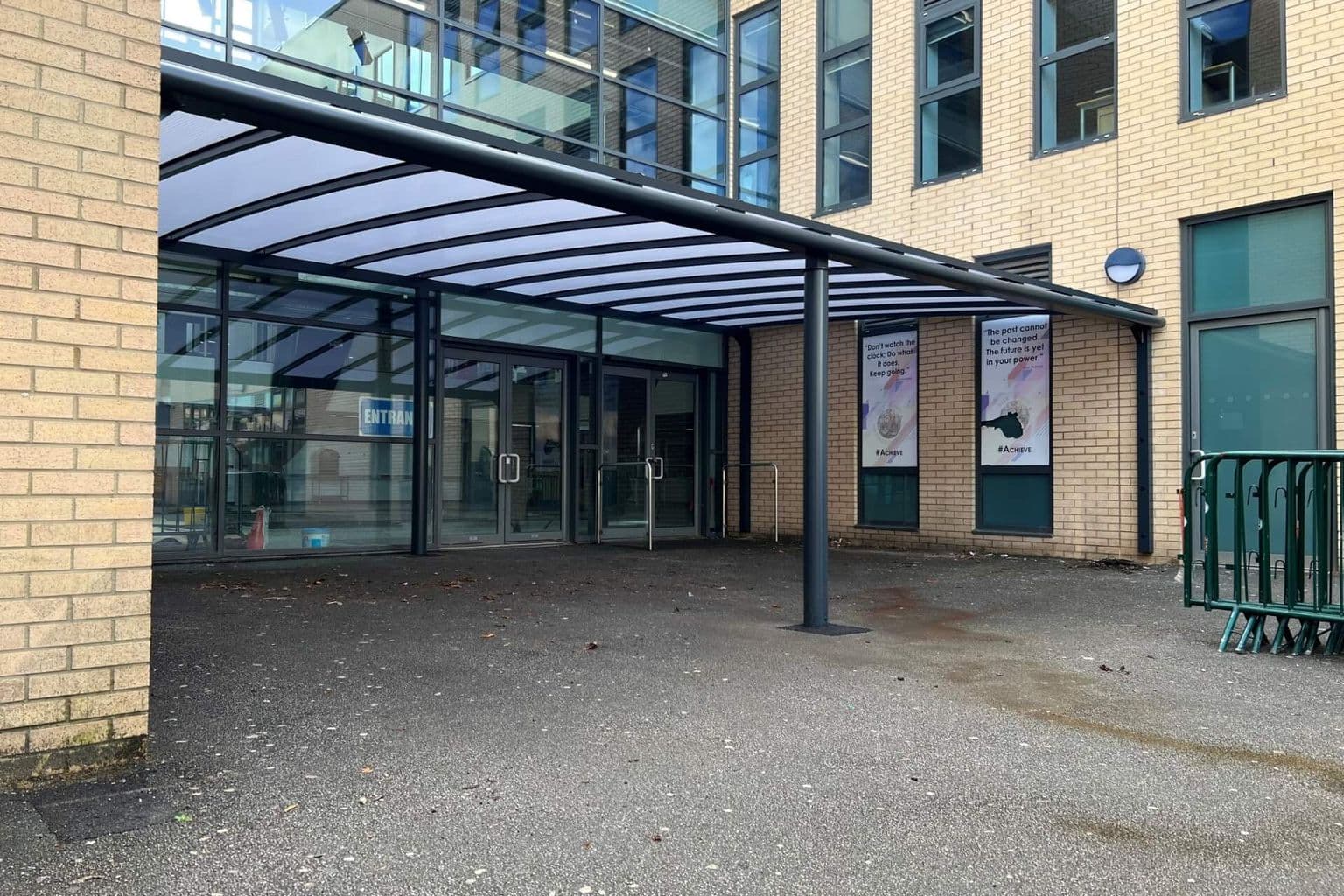
See the entrance canopies we build, or call 01704 547 321. If you would rather start on the form, request a quote.
Managing Director, Alotek Shelters Ltd
About Alex Thomas
Managing Director of Alotek Shelters since 2021. Trained in CAD and design at Southampton Solent University (BSc, 2:1). Design, fabricate and install from the Lancashire workshop.