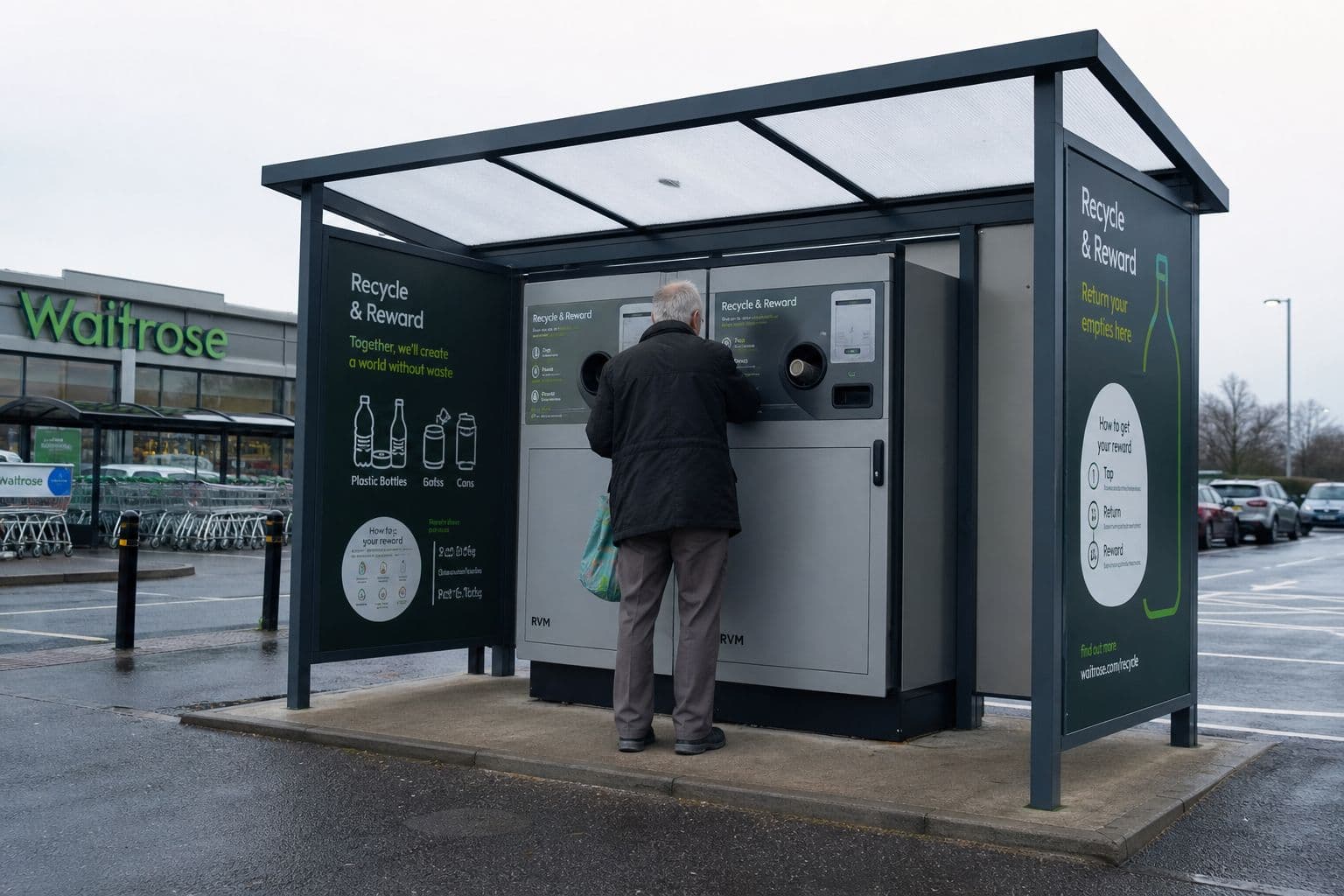
The Deposit Return Scheme: what retailers must do
The Deposit Scheme for Drinks Containers (England and Northern Ireland) Regulations 2025 established the UK Deposit Return Scheme, launching 1 October 2027. Under the scheme, a 20p refundable deposit is charged on all in-scope single-use drinks containers: PET plastic bottles and aluminium and steel cans between 150ml and 3 litres.
Every retailer that sells in-scope drinks must host a return point unless exempt. The exemption applies automatically to urban retailers with less than 100m² of retail floor space. Every other grocery retailer, convenience store, petrol forecourt, newsagent, and supermarket above that threshold must provide a return point from day one of the scheme.
Return points can be manual (a bin with staff collection) or automated via a reverse vending machine. RVMs are the preferred route for higher-footfall stores because they automate deposit refund, compaction, and data reporting to the scheme administrator.
| Retailer type | Obligation | Typical solution |
|---|---|---|
| Major supermarkets (Tesco, Sainsbury's, Asda, etc.) | Mandatory return point | Multiple outdoor RVMs with dedicated shelter canopy |
| Convenience chains and forecourts (>100m²) | Mandatory return point | Single or double outdoor RVM with canopy |
| Small urban stores (<100m²) | Exempt but can volunteer | Grant-funded RVM via Exchange for Change |
| Hospitality, leisure, schools (voluntary) | Optional return point | Single machine, may not require shelter |
Timeline pressure
Iceland Foods signed with Envipco for approximately 1,500 machines in June 2026, with delivery starting Spring 2027. Most major grocery estates teams are now in active procurement. Shelter canopies need to be ordered alongside or immediately after machine procurement to ensure installation is complete before October 2027. Lead time for a standard aluminium RVM canopy is 4 to 8 weeks from order.
Why a machine hood is not enough
The major RVM manufacturers offer integrated weatherproof caps or hoods as optional accessories on their outdoor-rated machines. TOMRA's S2 Rugged Plus has an optional hood. Envipco's Optima and Quantum have integrated weatherproof caps. These are designed for semi-outdoor environments with some natural shelter, not for fully exposed UK outdoor conditions.
Envipco's own published guidance states explicitly that "a small overhang above the machine is often not enough" and recommends coverage that extends forward to protect the customer's head and shoulders, protection along the top and sides of the machine front from driving rain and hail, and enough height and depth for customers to handle bags and crates of containers under cover.
In a typical UK retail car park, an RVM without a proper canopy is exposed to rain from multiple angles, frost, UV degradation, and wind-driven debris. Electronic components, payment screens, and barcode scanners are all affected by sustained moisture exposure. A proper shelter pays back in reduced machine downtime and longer equipment life, not just customer comfort.
Machine hood only
- No protection for customer standing at return slot
- Driving rain reaches screens and sensors
- No weather protection for handling containers
- Poor return rate in bad weather reduces scheme performance
Purpose-built canopy shelter
- Customer fully sheltered during return transaction
- Machine protected from all-weather exposure
- Year-round return rates maintained
- Signage panel space for DRS branding and instructions
Planning permission: what the 2026 legislation says
New Class CA permitted development rights came into force on 9 April 2026 under the Town and Country Planning (General Permitted Development etc.) (England) (Amendment) Order 2026. These rights explicitly cover RVMs and their associated shelters and canopies.
The legislation defines a reverse vending machine as including "any associated enclosure, building, canopy or other structure." This means the shelter is part of the RVM for planning purposes. You are not installing a separate structure that requires its own consent.
Class CA permitted development conditions
- Maximum footprint: 80m² gross floor space
- Maximum height: 4 metres
- Residential distance: Must be at least 15m from the boundary of any residential curtilage
- Highway facing: Must not face onto a highway if within 5m of the road
- Wall-mounted: If installed in a shop wall, must not protrude more than 2m beyond the wall surface
Planning permission is still required where the shop is a listed building or within the curtilage of one, within a Site of Special Scientific Interest, or on a scheduled monument. Conservation area restrictions may also apply. Check with your local planning authority if any of these apply to your site.
Importantly, Article 4 directions cannot remove the Class CA right. The government explicitly excluded Article 4 directions from applying to RVM installations to ensure the DRS rollout is not blocked by local planning restrictions.
Sizing your RVM shelter
The shelter needs to accommodate the machine footprint, customer clearance space in front of the return slot, and ideally space to set down bags or crates of containers. The following dimensions apply to the most common RVM models currently available.
| Machine model | Machine footprint | Min. shelter width | Min. shelter depth |
|---|---|---|---|
| TOMRA S2 Rugged Plus | ~0.9m × 0.6m (2.8m² to 5.4m² depending on model) | 2.0m | 2.5m |
| Envipco Optima / Quantum | ~0.9m × 0.7m | 2.0m | 2.5m |
| Double installation (2 machines) | 2 × single footprint with service gap | 4.0m | 2.5m |
| Multi-bay (3+ machines) | Bespoke to machine count and model | 5m+ | 2.5m to 3m |
Machine dimensions are indicative. Confirm exact dimensions with your RVM supplier before ordering the shelter structure. Allow 300-400mm service clearance at the rear of each machine.
The customer clearance dimension matters most
The return slot on an RVM is typically at waist height. The customer needs space to stand, feed containers one at a time, wait for the deposit credit, and retrieve their receipt or voucher. A minimum of 1.2m clear space in front of the return slot is the absolute minimum. 1.5m is comfortable. If the shelter is also used to drop off bags of containers, allow 2m depth from the return slot to the front edge of the canopy.
What to specify
Frame material
Aluminium powder-coated is the standard recommendation for outdoor retail installations. It does not corrode, requires no repainting, and can be powder-coated to any RAL colour to match corporate branding. Steel is less suitable for permanently outdoor structures in wet UK conditions unless hot-dip galvanised before powder coating.
Roof panels
UV-stabilised polycarbonate (opal or clear) is the most common specification. Opal polycarbonate diffuses light, reducing glare on screens and making the machine more comfortable to use in sunny conditions. Clear polycarbonate provides more natural light. Ensure panels are UV-coextruded with a minimum 10-year yellowing warranty. Toughened glass is an option for premium installations.
Back and side panels
A solid back panel (facing the building or prevailing weather) provides the most effective wind and rain protection without reducing machine accessibility. Side panels can be solid, partially glazed, or open depending on the site exposure. For high-footfall sites, a partially glazed side panel maintains visibility of the return point from the car park, encouraging use.
Colour and branding
Major grocery retailers will specify RAL colours to match brand standards. Tesco, Sainsbury's, Morrisons, Co-op, and M&S all have defined brand colours for external structures. Back panel space can incorporate a signage rail for DRS instructions and branding graphics. Specify this upfront. It is much cheaper to install a signage rail during manufacture than retrospectively.
Foundation
Most RVM canopies are installed on base plates bolted to the existing car park surface, avoiding groundworks. Where the surface is not suitable, a concrete pad foundation may be required. Confirm the ground condition and existing surface material when ordering. Most retail car parks are tarmac or concrete and are suitable for base plate installation.
Bespoke RVM shelters, made in the UK
We do not sell an off-the-shelf RVM shelter. If you need cover for an outdoor reverse vending machine, we can design and make a bespoke aluminium canopy to suit your machine model, the number of bays and your site.
- Single, double or multi-bay layouts
- Powder-coated in any RAL colour
- Made in our Lancashire workshop
- Supply and installation across the UK
Our entrance canopies show the kind of aluminium structure we build. Tell us the machine model and site and we will come back with a design and price.
Common questions
Do outdoor reverse vending machines need a shelter?
There is no legal requirement, but machine manufacturers state their hoods are not sufficient for harsh UK weather. A proper canopy protects the machine, improves customer experience, and extends equipment life. Retailers with higher footfall will see better return rates from sheltered installations.
Do I need planning permission for an RVM shelter?
In most cases, no. Class CA permitted development rights (April 2026) cover RVMs and their associated shelters. The legislation defines RVMs as including any associated canopy or enclosure. Exceptions apply for listed buildings and conservation areas.
What size shelter does a reverse vending machine need?
For a single RVM: minimum 2m wide by 2.5m deep. For a double installation: minimum 4m wide by 2.5m deep. Allow 1.5m clear customer space in front of the return slot minimum, and 300-400mm service clearance at the rear. Confirm machine dimensions with your RVM supplier before ordering.
When does the UK Deposit Return Scheme launch?
The UK DRS launches 1 October 2027 across England, Scotland, and Northern Ireland. All qualifying retailers must have return points operational from day one. Procurement of RVMs and shelters should be underway by Q1 2027 at the latest.
What material should an RVM shelter be made from?
Aluminium powder-coated to the retailer's brand RAL colour is the standard specification. It does not corrode, requires no maintenance, and can be produced to any colour. UV-stabilised polycarbonate roof panels are standard. Toughened glass is available for premium specifications.
Can you supply a framework agreement for multi-site programmes?
Yes. We work with estates teams and facilities managers on multi-site programmes, providing consistent specification, pricing, and installation scheduling across multiple locations. Call 01704 547 321 to discuss your requirements.