What Size Shelter Does a Reverse Vending Machine Need?

Alex Thomas
Managing Director
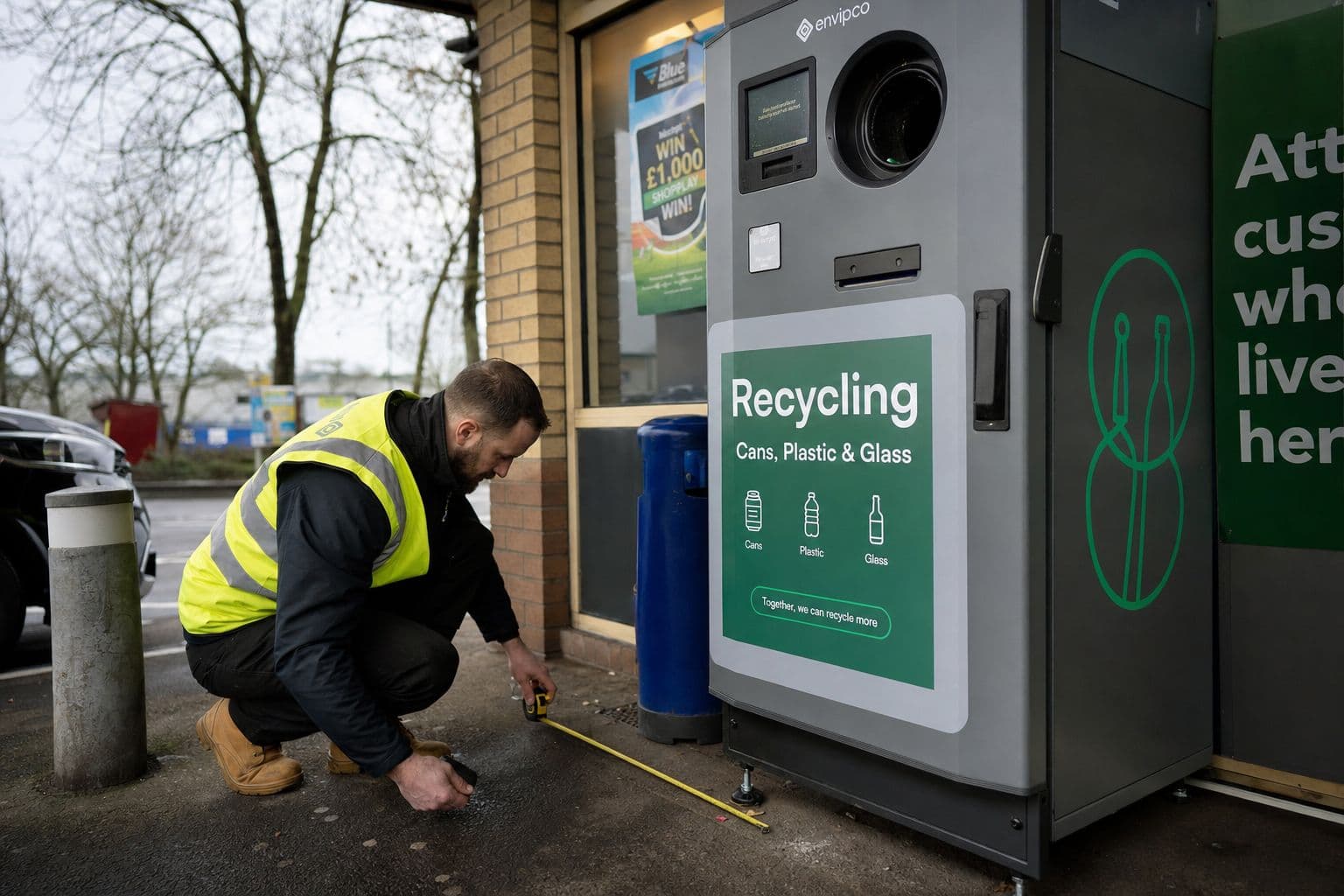
When retailers ask us to quote an RVM shelter, the first question is usually about machine type and how many machines they need to cover. The second question, which matters just as much, is about how much space the customer needs in front of the machine.
Getting the shelter depth wrong is the most common sizing mistake. A shelter that covers the machine but not the person standing at it is not doing its job.
Start with the machine dimensions
The two most common RVM models being deployed in the UK ahead of the October 2027 Deposit Return Scheme launch are made by TOMRA and Envipco.
TOMRA S2 Rugged Plus: the standard outdoor-rated TOMRA model for the UK DRS. Footprint varies by configuration: the compact version is approximately 0.9m wide by 0.6m deep. The full model with integrated storage is wider. Height to top of machine is approximately 1.8-2.0m. The S2 Rugged Plus has an optional overhead hood. But as TOMRA acknowledges, this is not a substitute for a proper shelter canopy in a fully exposed outdoor installation.
Envipco Optima and Quantum: Envipco's outdoor models, being deployed at Iceland Foods sites across the UK (approximately 1,500 machines from Spring 2027). Machine dimensions are broadly similar to TOMRA. Envipco's own guidance explicitly states that a proper external canopy is recommended for UK outdoor conditions beyond the integrated weatherproof cap.
Confirm exact dimensions with your RVM supplier before ordering the shelter. Machine configurations vary and a shelters manufacturer needs the precise width, depth, and height of the specific model being installed.
The customer clearance dimension
This is the part that catches people out.
The return slot on an RVM is at approximately waist height (800-1000mm from ground level). The customer stands facing the machine and feeds containers one at a time into the return slot. They then wait for the deposit credit to register on the screen and collect their receipt, voucher, or digital credit.
That process takes longer than most people expect, particularly for customers returning a full bag of bottles or cans. The person using the machine needs:
- Space to stand upright in front of the slot: minimum 600mm clear
- Space to handle a bag of containers without stepping outside the shelter: add 400-600mm
- Space for the next customer to queue under cover: add another 600mm if the site is high footfall
Minimum practical clear depth from the front face of the machine to the front edge of the shelter canopy: 1.2 metres for low-footfall sites, 1.5 metres as a standard recommendation, 2.0 metres for high-footfall installations.
Service access at the rear
RVMs require regular servicing: emptying the compaction bin, restocking receipt paper, cleaning the return slot, and periodic maintenance by an engineer. All of these require access behind or alongside the machine.
Allow a minimum of 300mm clear at the rear of the machine for routine access. For machines with rear-loading bins (the most common configuration for outdoor models), allow 600-800mm for the bin to be extracted and replaced during a service visit. This access space should be within the shelter footprint, not an afterthought.
Sizing the shelter: recommended dimensions
| Installation | Shelter width | Shelter depth | Notes |
|---|---|---|---|
| Single RVM, standard | 2.0m | 2.5m | Minimum practical for most sites |
| Single RVM, high footfall | 2.0m | 3.0m | Extra customer depth for busy stores |
| Double RVM | 4.0m | 2.5m | 300mm gap between machines plus margins |
| Triple RVM | 6.0m | 2.5m | Standard for larger supermarkets |
| Multi-bay (4+) | Custom | 2.5-3.0m | Site-specific; confirm with manufacturer |
Shelter height: a minimum internal clearance of 2.4m is recommended. Most customers and service engineers need 2.0m but the additional headroom makes the shelter feel less cramped and accommodates tall customers and engineers carrying equipment. Most standard RVM canopy designs are 2.5-3.0m to the underside of the roof.
Wall-mounted vs freestanding
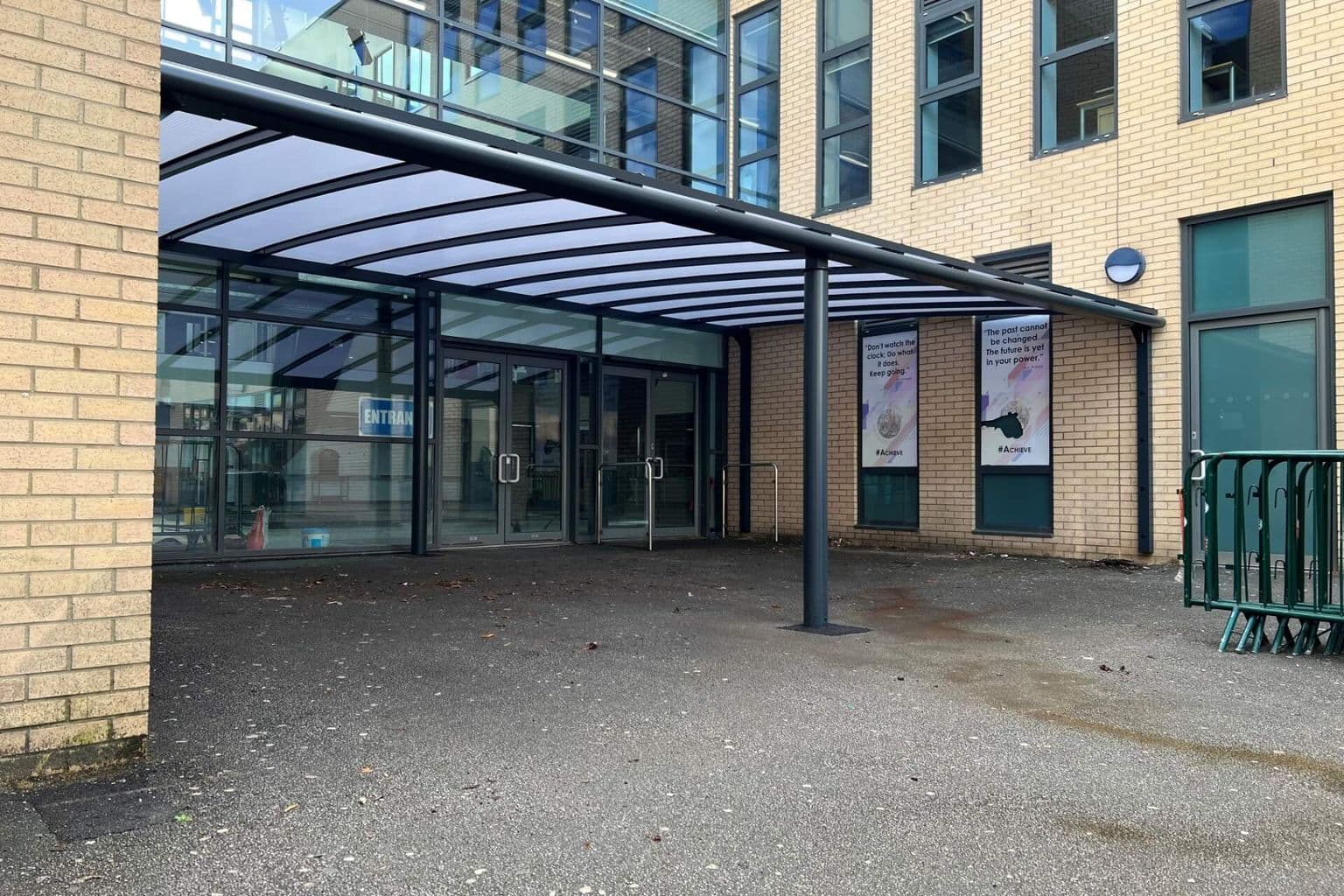
Most RVM canopies are freestanding on base plates bolted to the car park surface. This requires no groundworks in most cases and can be installed in a day.
Wall-mounted canopies, fixed to the back wall of the store, use the building as structural support and do not require rear posts. This is a cleaner visual solution where the RVM is positioned against the building facade, and reduces the structure's footprint. The wall attachment method needs to be confirmed for your wall construction.
For sites where the RVM is positioned away from the building, in the middle of a car park for example, a freestanding canopy with rear and side panels is the practical solution.
Planning considerations
Under the Class CA permitted development right (in force April 2026), the total footprint of the RVM installation including the shelter must not exceed 80m². Even the largest multi-bay installation at 10m × 3m only reaches 30m², well within this limit for any realistic retail deployment. See our detailed guide to the Class CA right: Reverse Vending Machine Planning Permission: The Class CA Right Explained.
For the full guide to specifying and procuring an RVM shelter ahead of the October 2027 DRS launch, read: Reverse Vending Machine Shelter Guide: What UK Retailers Need to Know Before October 2027.
Call 01704 547 321 or request a quote with your machine model and site details. We quote within 48 hours.
Managing Director, Alotek Shelters Ltd
About Alex Thomas
Managing Director of Alotek Shelters since 2021. Trained in CAD and design at Southampton Solent University (BSc, 2:1). Design, fabricate and install from the Lancashire workshop.