Cycle Shelters for Schools: Capacity, Security and What to Specify

Alex Thomas
Managing Director
Schools ring us about bike storage for two reasons. Either a Modeshift STARS or active-travel plan has just asked for covered parking, or the existing hoops by the gate are full, wet, and losing bikes.
A cycle shelter is a small structure compared with a playground canopy. It is also easy to specify badly. Too few spaces, stands too close together, a lockable cage nobody can supervise, or a pretty roof with no stands at all. Then pupils keep chaining bikes to the railings.
This is the specification I walk through with school business managers. We manufacture the shelters in Lancashire and install them with a DBS-checked team.
Start with how many bikes, not how many metres
Capacity is not "a 4 metre shelter." It is the number of usable spaces once stands are spaced so handlebars do not lock together.
Sheffield stands are the default for schools. One stand takes two bikes if you use both sides. Space stands at about 1 metre centres. That is the spacing police cycle officers and most local-authority active-travel teams expect. Closer than that and you have sold a capacity figure nobody can use.
Two-tier racks roughly double the count in the same footprint. They suit secondary schools and staff e-bikes where ground space is tight. They do not suit most infant pupils. Younger children cannot lift a bike onto an upper rail, and staff will not do it for them every morning.
A working rule of thumb:
| School type | Typical first install | Why |
|---|---|---|
| Infant or nursery | 5 to 10 spaces, single-tier | Staff bikes and a few balance bikes or scooters |
| Primary | 10 to 20 spaces | Pupil bikes plus staff. Grow later if STARS numbers rise |
| Secondary or all-through | 20 to 50+ spaces, often two-tier for staff | Peak arrival is short. Queuing matters |
| Specialist setting | 10 spaces, lockable, close to reception | Staff-led, supervised, often combined with a buggy store |
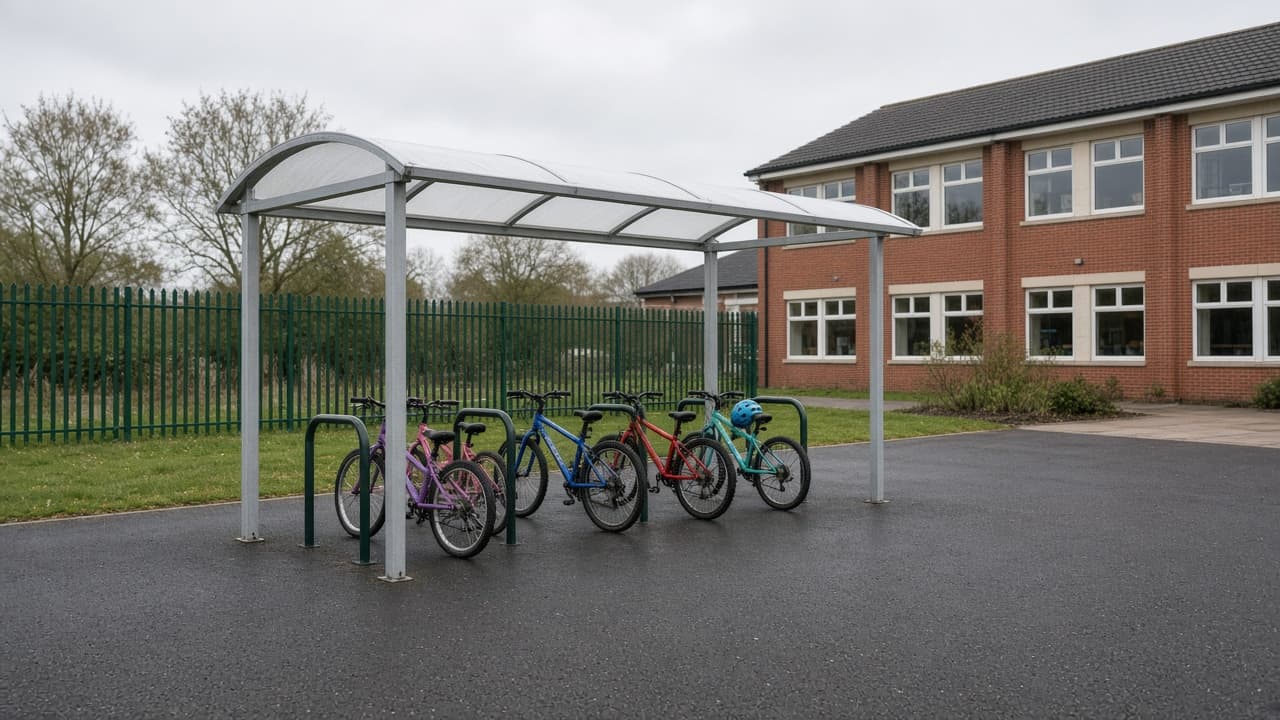
We regularly install a 10-space shelter as the first unit. At Fox Hollies School that was a 4.1m x 2.1m 10-space shelter. At Flanshaw the school wanted an arc-roofed 4m x 4m bay. Both are still the same product family: aluminium frame, covered roof, proper stands.
If you already know you will need 40 spaces in three years, say so now. One longer run is cheaper than two visits, and the concrete can be sized once.
Security: cover is not the same as secure
Weather protection and theft protection are different jobs.
Open front, roof only. Cheapest, fastest, and the right answer for most primary playgrounds that are locked out of hours. Pupils see their bike, staff can see the bay from a duty point, and there is nothing to unlock at 8.40am.
Open front, Sheffield stands. This is the standard school spec. The pupil uses their own lock through the stand. The roof keeps saddles and belts dry. Theft risk drops because the bike is locked to something solid, not to itself.
Lockable doors or a gated front. Worth it for staff bikes, e-bikes, and any site that is open to the street or used as a cut-through. A lockable shelter needs a key or code routine that actually happens. If the site manager is the only keyholder and they start at 8am, pupils arriving at 7.50am will not use it.
Do not specify a fully enclosed box in a hidden corner. You will create a safeguarding problem and a graffiti magnet. Put the shelter where a duty adult can see it: near the pedestrian gate, beside the staff car park, or on the route pupils already walk. At Lichfield Cathedral Junior School the cycle shelter went in with the canopies as one coordinated job, which is tidier than dropping a cage in later.
What to write on the specification
If you are going out to three quotes, put this on the sheet so you get like-for-like prices:
- Frame: powder-coated aluminium, not painted steel. Steel is cheaper on day one and rusty by year five on a wet playground.
- Roof: UV-stable polycarbonate or profiled metal. Polycarbonate keeps the bay lighter. Metal is more opaque and a bit tougher if you expect footballs.
- Stands: Sheffield, 1 metre centres, included in the price. Confirm how many bikes that actually equals.
- Finish: any RAL colour. We include this as standard. Match the school crest colour if you want it used in the prospectus photo.
- Base: concrete pad, typically 100mm, or resin anchors into sound existing slab. Ask the supplier to state which, and who is doing the groundworks.
- Install: DBS-checked team, school-holiday or weekend preferred, one to two days for a standard bay.
Optional, only if you need them: lockable gates, a scooter rail for infants, an extended front overhang so handlebars stay dry in driving rain, and a two-tier rack for staff.
Where it should sit on the site
I have seen perfectly good shelters fail because they were put in the wrong place.
Too far from the gate. Pupils will not detour behind the sports hall with a bike and a violin. Put storage on the route they already take.
In a dead corner. Out of sight of reception and the playground duty point. That is where bikes disappear and where you do not want pupils lingering.
On soft ground. Grass looks neat on a plan. After one wet term the approaches are mud and parents complain. Specify a hard standing to the stands, not just under the roof.
Blocking a fire exit or a refuse route. Check both before you fall in love with a drawing. We pick this up on the free survey. It is cheaper than moving a pad.
Planning is usually straightforward on an existing school site. Listed buildings and conservation areas still need a check. A lockable enclosure can attract more planning interest than an open-sided roof. We flag that before you order.
What it costs
Cycle shelters are one of the more affordable school structures we make. Education list prices start from £750 plus VAT for the smallest open bay. Realistic supply-and-install bands for 2026:
| Specification | Spaces | Supply and install |
|---|---|---|
| Open roof, Sheffield stands | 5 to 8 | £750 to £1,800 |
| Standard school bay | 10 | £1,800 to £3,200 |
| Larger open bay | 20 | £3,200 to £5,500 |
| Lockable 10-space | 10 | £3,000 to £5,000 |
| Two-tier or 30+ spaces | 30 to 50 | £5,500 to £12,000+ |
Foundations, a new path to the gate, and any lock hardware you want us to fit sit on top. VAT extra.
That is still a different conversation from a playground canopy. If the same governors' meeting is also looking at covered play, keep the two budgets separate so the bike shelter does not get cut to pay for dining cover.
Funding and active travel paperwork
A cycle shelter is easier to justify than a large canopy. It maps cleanly onto Modeshift STARS, a school travel plan, and most local-authority active-travel or sustainable-travel grants. PTA fundraising also works at the 10-space end.
SCA can pay for it if the trust treats it as estate improvement. CIF on its own is the wrong fund for a bike shelter. If you are already writing a wider capital bid, you can include it, but do not wait for CIF to solve a STARS action.
For the capital rules that sit behind larger outdoor structures, see How Schools Fund a Covered Walkway: SCA vs CIF.
What happens on our side
You send a photo of the proposed spot and a headcount (pupils who already cycle, plus a guess at what a proper shelter would unlock). We confirm capacity, stand type, and whether the ground will take a pad. Then a fixed quote.
Most school cycle shelters install in a day or two in the holidays. We manufacture in Lancashire, powder-coat to your RAL, and do not leave you to find a local fitter who has never worked on a school site.
View cycle shelters for schools, look at the school installs in our case studies, or call 01704 547 321. Request a quote if you already have measurements.

Managing Director, Alotek Shelters Ltd
About Alex Thomas
Managing Director of Alotek Shelters since 2021. Trained in CAD and design at Southampton Solent University (BSc, 2:1). Design, fabricate and install from the Lancashire workshop.