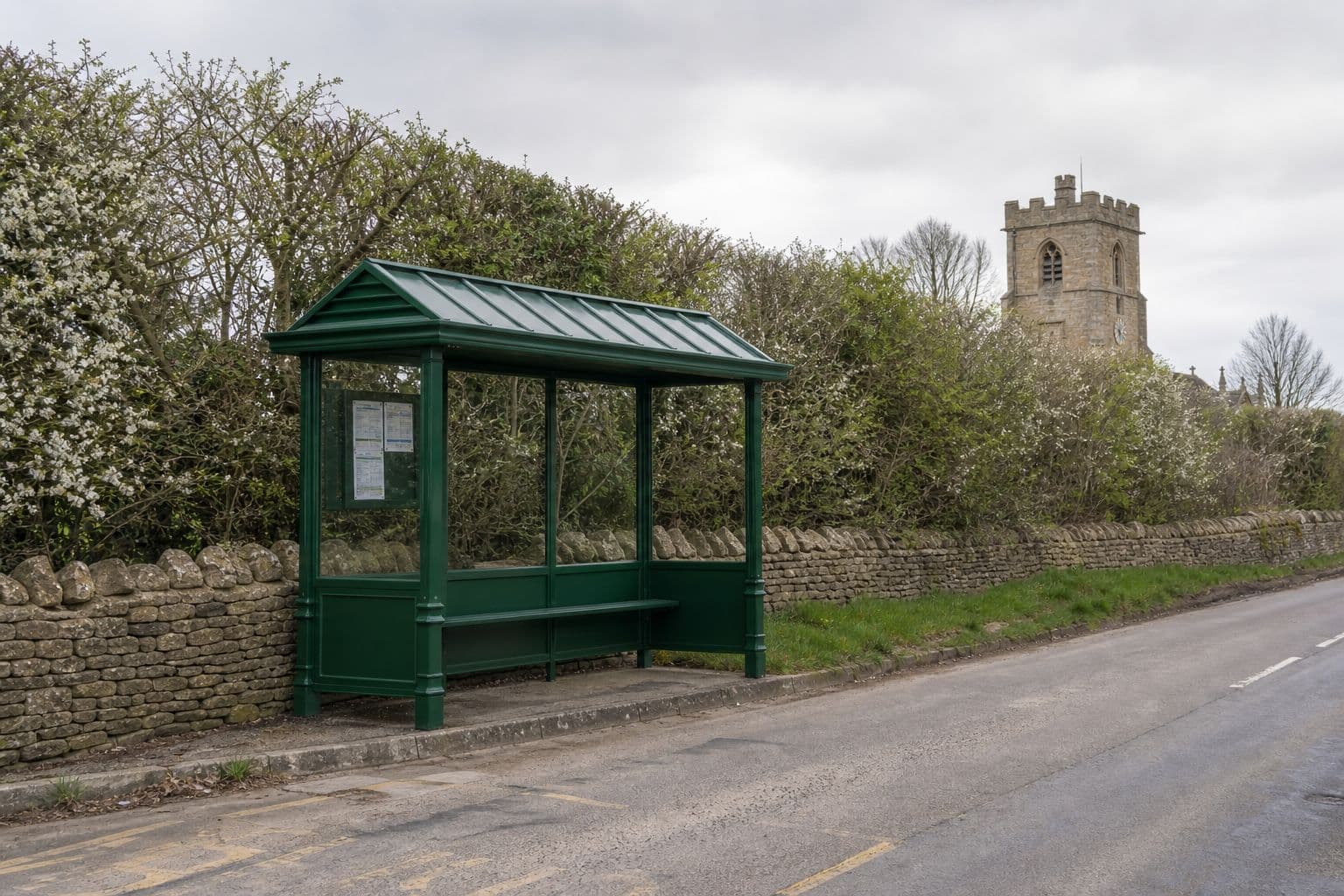

Most parish clerks and councillors buy a bus shelter once, maybe twice, in a decade. It is not the kind of project you build expertise in. Yet the process involves the highways authority, potentially the planning authority, a procurement decision on behalf of the community, and the knowledge that whatever you choose will be standing there for the next 25 years. This guide is written to make that process straightforward.
Read as text
- Check who owns the shelter and whether planning permission applies. On the public highway it is usually permitted development, so no planning application is needed.
- Get a site survey. Ours is free and typically takes 30 to 45 minutes.
- Get quotes and council approval. Council meeting cycles for budget approval typically take six to eight weeks.
- Get highways authority approval. It is always required and takes four to twelve weeks. Do not place an order until you have it.
- Manufacture and installation: typically four to six weeks from order.
- Allow three to six months from first enquiry to installation for a straightforward project.
Read the transcript
The old shelter at the village stop has had its day. Here is how a parish council gets a new one in the ground, from first idea to finished shelter. First, check who owns the stop. Parish councils own many village shelters; the county council owns others. On the public highway, a shelter is usually permitted development, so no planning application is needed. Next, a free site survey. It usually takes thirty to forty-five minutes, and you get the dimensioned drawings the highways team will ask for, at no extra cost. Then quotes, and a decision at council. Meeting cycles mean budget approval usually takes six to eight weeks, so start early. Highways approval is always needed, even when planning permission is not. It takes four to twelve weeks. Do not place an order until you have it. We then make your shelter in our Lancashire workshop, and our own team installs it, usually four to six weeks from order. Allow three to six months in all. Start with a free site survey from Alotek.
Who is responsible for bus shelters?
Before spending a penny, understand who owns what. Responsibility for bus shelters in England is split and often unclear.
The highway authority, usually the county council, has the power to install and maintain bus shelters on public highways under the Highways Act 1980. Many county councils own and maintain a proportion of shelters on busier routes. But in rural areas and smaller settlements, that coverage is patchy and parishes are often left to make their own provision.
Parish and town councils own and maintain many bus shelters, particularly in rural communities. Where the parish owns the shelter, it is responsible for maintenance, insurance, and eventual replacement. The parish precept is the usual source of funding for this.
District or borough councils sometimes own shelters in market towns and urban fringe areas. If you are not sure who owns the shelter you want to replace, check with your county council highways department or your district council assets team. Replacing a shelter you do not own creates complications.
Where there is currently no shelter at a stop and the parish wants to provide one, the parish council typically leads on the project: fundraising the budget, running procurement, obtaining highways approval, and commissioning installation.
Do you need planning permission?
This is the question clerks ask most often, and the honest answer is: it depends on two things: where the shelter is going, and what it includes.
On the public highway: permitted development
Bus shelters installed on the public highway by or on behalf of a parish council are generally classed as permitted development under Part 12, Class A of the Town and Country Planning (General Permitted Development) Order 2015. This means no formal planning application is required with the local planning authority.
This applies to the majority of parish council bus shelter projects, such as replacing an old timber shelter at a roadside stop, or installing a new shelter at an existing bus stop on a public road.
When planning permission is required
Four situations typically require a formal planning application:
- Private land. If the shelter is on land not forming part of the public highway (a village green, a car park, or land owned by a landowner who has given permission), it does not benefit from highway permitted development rights and a planning application is needed.
- Conservation areas. Permitted development rights are reduced or removed in conservation areas. Contact your local planning authority before proceeding. They may impose conditions on design, materials or colours.
- Listed building curtilage. Structures within the curtilage of a listed building require listed building consent as well as planning permission. This is rare for bus shelters but worth checking if the stop is adjacent to a listed property.
- Advertising panels. Any shelter that includes an advertising panel or display requires separate advertisement consent, regardless of where it is located. Most parish council shelters do not include advertising, so this rarely applies.
If you are in any doubt, a pre-application enquiry to your local planning authority costs very little and removes uncertainty before you spend money on a shelter.
Highways authority approval: always required
Whether or not you need planning permission, you always need approval from the highways authority before installing anything on or adjacent to the public highway. This is separate from planning permission and is not optional.
The highways authority will assess the proposed location for safety, confirm the acceptable footprint and clearances, and specify any associated highway works needed such as DDA kerbing. They will also confirm whether the installer needs to give notice under the New Roads and Street Works Act (NRSWA) and whether traffic management is required during installation.
Contact your county council highways department early, typically their passenger transport infrastructure team. In some counties this process is well-established and straightforward; in others it takes time. Build it into your timeline from the start.
What does a parish council bus shelter actually cost?
The cost of a bus shelter is usually quoted as the supply price of the shelter itself. The full project cost is higher. Here is the honest breakdown:
| Cost element | Typical range | Notes |
|---|---|---|
| Shelter supply (heritage design, mid-spec) | £3,500 to £7,500 | Varies by size, design, glazing type |
| Shelter supply (standard flat-roof design) | £2,500 to £5,000 | Smaller range, fewer variables |
| Foundation and groundworks | £800 to £2,500 | Depends on ground conditions and existing base |
| DDA kerbing (Kassel kerbs or flush kerbs) | £500 to £2,000 | Required by most highways authorities |
| Traffic management during installation | £400 to £1,500 | Required on most public roads |
| Utility surveys and clearances | £200 to £600 | Essential before any groundworks |
| Removal and disposal of old shelter | £300 to £800 | If replacing an existing structure |
| Highways authority fees (some councils charge) | £0 to £500 | Varies significantly by authority |
| Total project budget | £6,000 to £18,000 | Plan for the high end on a first project |
The single biggest variable is groundworks. A straightforward installation on a firm, level footway with an existing base is quick and cheap. A soft verge, an uneven site, or a location requiring significant DDA infrastructure improvement can double the groundworks cost. Always get a site visit before budgeting.
For whole-life cost, aluminium shelters win decisively. An aluminium shelter installed today should still be standing in 25 to 30 years with no painting, no rot treatment, and only minimal cleaning. Timber shelters typically require repainting every three to five years (£300 to £600 per repaint), and often need full replacement after 15 years. Over 25 years, the maintenance cost of a timber shelter usually exceeds its original purchase price.
How do parish councils fund bus shelters?
Parish council budgets are tight and precept increases are unpopular. But there are more funding routes than most clerks realise. The key is knowing what to ask for, and who to ask.
Read the transcript
Most parish councils assume a new bus shelter means raising the precept. Often it does not. There are more funding routes than most clerks realise. Start with your reserves. A shelter is the kind of one-off capital project they are there for. If you do use the precept, present it as one project, with a clear cost and a clear benefit. Next, call your county council's passenger transport team. Some counties pass Bus Service Improvement Plan money to parishes through shelter grant schemes. Ask whether yours does. Your county councillor may also have a locality budget for projects in their division. A short email with a quote is often enough to start that conversation. Ask your district council about Section 106 money from housing developments near you, and whether the UK Shared Prosperity Fund covers rural transport in your area. Many projects combine two or three of these, with community fundraising to close any gap. Start with a free site survey and a quote from Alotek that you can take to each funder.
1. The parish precept
The most straightforward route. A bus shelter costing £10,000 in a parish with 500 households adds £20 to the annual precept per household, or £1.67 per month. Present it that way at the council meeting. Spread over three to five years via a capital reserve fund, the precept impact is typically pennies per month per household. Most residents consider it reasonable when framed correctly.
2. BSIP grants via the county council
The Bus Service Improvement Plan (BSIP) is the national framework through which the Department for Transport funds bus infrastructure improvements. Many county councils distribute a proportion of their BSIP allocation to parish councils through rural bus shelter grant schemes.
Hampshire County Council, for example, has run a Parish Council Bus Shelter Grant Scheme offering grants of up to £15,000 for shelter refurbishment or replacement. Similar schemes exist or have existed in other counties. These are not universally available. Availability depends entirely on whether your county council has chosen to create a parish-facing scheme from its BSIP allocation.
Contact your county council's passenger transport team and ask directly: do you have a parish council bus shelter grant scheme? What is the current application process? Even if a formal scheme does not exist, a direct request to the passenger transport team can sometimes unlock a capital contribution, particularly where there is documented passenger need at the stop.
3. County councillor locality budgets
Most county councillors have a discretionary budget (variously called a locality budget, community fund, or member grant) to allocate to projects in their division. Amounts vary by council but are typically £3,000 to £15,000 per year per division. A bus shelter is exactly the kind of community infrastructure project these budgets exist to support.
Talk to your county councillor. Ask whether they have unspent locality budget. This is often the fastest route to a capital contribution.
4. Section 106 developer contributions
Where a housing development has been granted planning permission in your area, a Section 106 agreement may include contributions towards transport infrastructure including bus stops and shelters. Check with your district council planning department whether any S106 monies are available in your parish for transport purposes. Many parishes miss this route because they do not know to ask.
5. UK Shared Prosperity Fund (UKSPF)
The UKSPF, administered by district councils, funds local projects including rural connectivity and transport. The fund is project-specific and competitive, but bus infrastructure in rural areas fits squarely within its aims. Check with your district council whether UKSPF funding is available for transport projects in your area and what the application process is.
6. Community fundraising
For smaller parishes where the above routes do not cover the full cost, community fundraising via a parish fund, village trust, or local charity can plug a gap. A bus shelter is a tangible, popular project that tends to attract donations from local residents, particularly older members of the community who rely on bus services. A £2,000 to £3,000 community fundraising contribution is not unusual on top of a mix of the routes above.
For the full deep-dive on funding routes, read: How Parish Councils Fund Bus Shelters: Precept, BSIP Grants and Section 106 Explained.
Heritage vs modern: choosing the right design
Design choice is where parish councils spend the most time and cause the most debate. Here is how to think about it practically.
The case for a heritage-profile shelter
A pitched-roof shelter in Traffic Black or Moss Green fits naturally into village settings, conservation areas, and historic parishes. It references the traditional timber shelters most villages have always had, without the maintenance problems that come with timber. For parish councils with a conservation area designation or a village character statement, a heritage profile will usually pass highways authority and planning requirements with less friction.
Heritage shelters are also less likely to attract resident objections at the planning or consultation stage. A glass box divides opinion. A dark green pitched-roof shelter generally does not.
The case for a modern flat-roof design
On busier roads, in town centres, or at high-footfall stops, a modern flat-roof design offers better sightlines for bus drivers and passengers. The open structure is more visible and can feel safer at night. If your stop is on an A-road or a busy high street rather than a village lane, the heritage profile may look incongruous.
Practical design checklist
- Is the site in a conservation area? If yes, check with your local planning authority before committing to a design.
- What colour are other shelters in the parish? Consistency matters to residents.
- Does the parish council have a local design guide or village character statement that specifies colours or materials?
- Will the shelter be visible at night? If so, consider solar lighting as an option. It adds cost but removes the need for a mains connection.
- What is the footway width? Narrow footways constrain the shelter footprint and may rule out wider heritage designs.
We can provide 3D renders showing how either design will look at your specific site. Most councils find that seeing the shelter in context, rather than looking at product photos, makes the decision straightforward. Read more about when to replace a wooden bus shelter and what to replace it with.
DDA compliance: what it actually means in practice
Every new bus shelter installation must meet the accessibility requirements of the Equality Act 2010. Highways authorities will not approve installations that do not meet these standards. In practice, DDA compliance for a bus shelter means:
- Raised kerbing. The kerb at the boarding point must be raised to a standard height (typically 140mm or 160mm, depending on your highways authority) to allow wheelchair users and passengers with mobility impairments to board and alight at level or near-level. This is often the most significant cost in the groundworks budget.
- Clear passageway. A minimum 1500mm clear width must be maintained between the shelter structure and the kerb edge for wheelchair users to pass. This affects the shelter footprint and placement.
- Accessible seating. Seating with armrests on at least one side assists elderly and disabled passengers in sitting and standing.
- Tactile paving. Some highways authorities require tactile paving at the boarding point. Confirm requirements with your highways department.
- No obstructions. Nothing within the waiting area, such as signage, bins or cycle parking, should obstruct the 1500mm passageway.
If the existing footway does not meet these standards, the groundworks to bring it up to standard form part of the project cost. This is one reason actual project costs regularly exceed the shelter supply price.
Working with the highways authority: a practical guide
The highways authority is not an obstacle. They are a necessary part of the process, and the parish councils that handle this well treat them as a partner rather than a gatekeeper.
Start by identifying the right contact. The relevant team is usually called the passenger transport infrastructure team or bus stop infrastructure team within the county council highways department. In some counties, district councils manage bus stop infrastructure; in others it is entirely county. A phone call to the main highways switchboard will get you to the right team.
What to say in the first contact: you are a parish council clerk, you want to install a new bus shelter at a specific stop (give the postcode or location), and you need to understand the approval process. Ask: what are the site requirements, are there any known constraints, what highway works will be required, and what documentation do you need from us and our contractor?
What you will need to provide: a dimensioned drawing showing the shelter footprint, its position relative to the kerb, and the clear passageway width. A specification sheet for the shelter. Sometimes a manufacturer's certificate of compliance with relevant BS standards. We provide all of this as part of our standard quotation process.
Allow four to twelve weeks for highways authority approval, depending on the authority. Some are efficient and turnaround in weeks. Others are slower. Do not place an order with a shelter manufacturer until you have highways approval, or at least a clear indication that approval will be granted. Otherwise you may have a shelter sitting in a warehouse while the paperwork catches up.
The procurement process for parish councils
Most parish councils are subject to standing orders and financial regulations that govern how they procure goods and services. For a bus shelter project, this typically means:
- Under £2,500: Clerk has delegated authority; single quote acceptable in most councils.
- £2,500 to £25,000: Council resolution required; minimum three written quotes standard.
- Over £25,000: Formal tender process required; OJEU threshold considerations no longer apply post-Brexit, but most councils still follow a structured tender for contracts above this value.
Check your own standing orders. They take precedence. If you are unsure whether your project requires three quotes or a formal tender, ask your internal auditor or your local NALC (National Association of Local Councils) county association for guidance.
When comparing quotes, compare the total installed cost (shelter, groundworks, DDA works, traffic management), not just the shelter supply price. A cheaper shelter with higher groundworks costs can easily be more expensive in total. Ask each supplier for a fixed-price all-in quote for the complete project, and confirm what is and is not included.
What to ask for in a site survey
Before going out to quote, a site survey by an experienced shelter manufacturer is worth doing. At Alotek, a site survey is free and typically takes 30 to 45 minutes. We look at:
- Footway width and the available footprint for the shelter
- Ground conditions and any likely complications for foundations
- Existing kerb heights and what DDA works will be required
- Underground services (gas, electric, water, telecoms) that will need to be surveyed before groundworks
- Access for installation vehicles and any traffic management requirements
- Line of sight considerations for bus drivers
- Whether solar lighting is viable given the site aspect
A good site survey takes the guesswork out of your budget and gives the highways authority confidence that the application is well-prepared. Call us on 01704 547 321 or request a free survey online.
Frequently asked questions
Do parish councils need planning permission for a bus shelter?
Who is responsible for bus shelters in a parish?
How much does a parish council bus shelter cost?
Can a parish council get a grant for a bus shelter?
What is DDA compliance for a bus shelter?
Do I need to involve the highways authority even if it is not a planning application?
What design should a parish council choose for a village setting?
How long does it take to get a parish council bus shelter installed?
Can Alotek help with the highways authority application?
Ready to start your project?
A free site survey gives you the drawings and information you need for highways approval, council budget approval, and a fixed-price quote.
Related guides and resources
How Parish Councils Fund Bus Shelters
Precept, BSIP grants, Section 106 and county councillor locality budgets explained in full.
BlogWhen to Replace a Wooden Bus Shelter
How to assess condition, what the real replacement cost is, and why timber keeps losing to aluminium.
ProductParish Council Bus Shelter Product Page
Heritage and modern profiles, design options, specifications and parish project photos.
ServiceBus Shelter Repairs
Existing shelter damaged or vandalised? Find out about repairs before you replace it.