School Canopy vs Covered Walkway: Which One Does Your School Actually Need?
Alex Thomas
Founder & Director
I get this question at least once a week. A school business manager or headteacher calls up and says something like: "We need more covered outdoor space. We're thinking either a canopy or a covered walkway. What's the difference?"
It's a good question, and the honest answer is: it depends entirely on what problem you're trying to solve.
After working with schools for 30 years, I've seen both done brilliantly and both done badly. The bad ones almost always happened because the school chose the structure type before they'd properly defined the problem.
So let's work through it.
What Is a School Canopy?
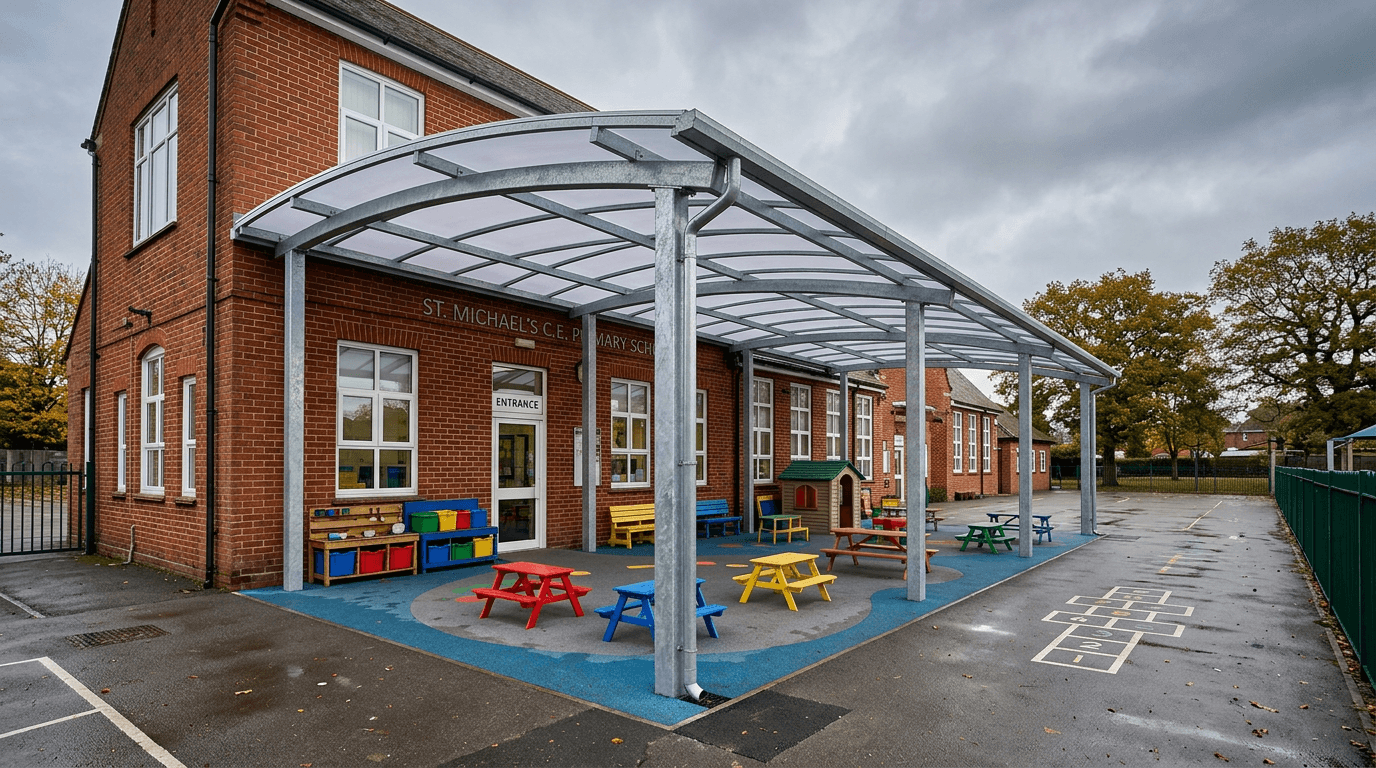
A school canopy is a fixed overhead cover attached to or positioned near a school building. It creates a sheltered area that functions as an extension of the indoor space, outdoors.
Think of it as a covered outdoor room. Kids can eat there, work there, play there, and have lessons there. It doesn't lead anywhere in particular. It's a destination.
Common uses:
- Outdoor dining and lunch areas
- Covered play areas
- Outdoor classroom space
- Waiting areas for parent pickup
- Outdoor reading or art areas
Canopies come in many forms: lean-to canopies attached to a wall, free-standing canopies with their own columns, and sail-style canopies for larger open areas. Sizes range from small covered entrances to large structures covering hundreds of square metres.
What Is a Covered Walkway?
A covered walkway connects two points. It's designed for movement. You walk under it to get from one building to another, from one part of the site to another, without getting wet.
It's not primarily a destination. It's a route.
Common uses:
- Connecting main school building to a separate hall, sports block, or mobile classroom
- Covered path from car park or gates to entrance
- Linking two separate wings of a split-level school
- Outdoor corridor for daily movement between lessons
Covered walkways are typically narrower than canopies (1.5 to 3 metres is typical) and longer. They follow a route rather than covering a fixed area.
The Key Question to Ask Yourself
Here it is, the question that actually settles this for most schools:
Are you trying to cover a space, or cover a journey?
If your problem is "we have no covered outdoor area for kids to use," that's a canopy.
If your problem is "kids are getting soaked every time they walk from the main building to the dining hall," that's a covered walkway.
If your answer is "both, actually," you might need both. Or you might need a hybrid design that serves both purposes.
When a Canopy Is the Right Choice
Outdoor Dining
If your school doesn't have a dedicated covered outdoor dining space, a canopy will transform your lunch times. Pupils eat outside, the hall is less crowded, and there's a natural separation between eating and indoor learning spaces. Schools that add covered outdoor dining consistently tell us it reduces indoor congestion and feels like a proper upgrade to school life.
Outdoor Learning
For schools with a commitment to outdoor education or forest school activities, a canopy gives you a proper base. A well-sized canopy (4 to 6 metres wide, 6 to 10 metres long as a rough guide) is large enough for a whole class and gives teachers a reliable space regardless of the weather.
Entrance Shelter
A canopy over the main school entrance or at the gate makes morning drop-off and afternoon pickup significantly less chaotic in wet weather. Parents wait under cover. Kids line up under cover. Staff aren't soaked. It seems small but the impact is real.
Budget
Canopies tend to cost less per square metre of covered space than covered walkways, partly because they have simpler structural requirements. If your budget is tight and your priority is covered area, a canopy often gives more bang for your money.
When a Covered Walkway Is the Right Choice
Separated Buildings
This is the most common reason schools come to us for covered walkways. A detached hall, a mobile classroom, a sports block across the site. Every time a class changes, half the school walks across open ground. In October through March, that's a problem every day.
A covered walkway solves it permanently. It's not glamorous. It doesn't look as impressive as a big canopy. But it removes a genuine daily friction from school life, and staff notice immediately.
Long Routes in Exposed Locations
Some school sites are exposed. Wind funnels between buildings, or the prevailing weather comes from one direction and hits unprotected paths. A covered walkway with appropriate side panels can turn an unpleasant crossing into a non-issue.
Safeguarding and Supervision
This is one schools don't always think about initially. Covered walkways can improve sight lines and create clear, defined routes for pupil movement. Some schools have found it actually helps with supervision of transitions between lessons.
When You Might Need Both
Some schools genuinely need both. A typical scenario:
The school has a dining hall in a separate building (walkway needed) and wants covered outdoor classroom space (canopy needed). These are separate problems requiring separate solutions.
It's perfectly reasonable to plan both, and you can often phase them if budget is a constraint. Most schools prioritise whichever problem is causing the most daily disruption.
What About Hybrid Designs?
We do build hybrid structures. A covered walkway that widens out at one end to create a small canopied area, for instance. These can work well but cost more to design and install than a straightforward structure of either type.
I'd only recommend a hybrid if you genuinely need both functions in the same space, not as a way of trying to solve two problems with one structure on a tight budget.
Practical Considerations Before You Decide
A few things worth thinking through before you commit to either:
Planning permission: Most school canopies and covered walkways fall under permitted development for educational buildings, but it's worth checking with your local planning authority before assuming. Conservation areas or listed school buildings may have restrictions.
DBS-checked installation: Any contractor working on a school site needs appropriate DBS clearance for their installation team. Make sure you ask. We have this covered as standard.
Groundworks: Both canopies and covered walkways need proper foundations. Check whether your chosen area has underground services, and factor in the cost of base preparation.
Timing: School projects are most easily installed during summer holidays. For a canopy or walkway, allow 8 to 12 weeks from survey to installation. Plan accordingly.
Getting the Right Advice
The best way to make this decision is to have someone walk your site with you. We offer free site surveys to all schools, no obligation. We'll look at your site, understand what you're trying to achieve, and give you our honest recommendation, even if that recommendation is to start with something smaller than you'd planned.
Call us on 01704 547 321 or request a survey online.
We work with primary schools, secondary schools, nurseries, and academies right across the UK. If you're curious what we've done for schools in your area, have a look at our case studies or browse the school canopies product page and covered walkways page.
About Alex Thomas
Founder of Alotek Shelters with 30+ years of experience in outdoor structures. Known for attention to detail and a relaxed, practical approach to problem-solving.
Get in touch →