How Covered Walkways Increase Outdoor Learning Time in UK Schools

Alex Thomas
Managing Director
British weather. We all know it. Four seasons in one day, and that's just on a good day.
For schools, this creates a genuine problem: how do you get kids outside when it's drizzling half the time? And yes, I know kids don't melt in rain. But try teaching maths outdoors in February drizzle and let me know how that goes.
Over the years, I've worked with dozens of schools who've added covered walkways or outdoor canopies. The feedback's been consistent: more outdoor time, better engagement, happier teachers. One primary school head told me it added roughly 30% more usable outdoor time across the school year.
Let me break down why covered walkways actually work.
The UK Weather Reality
Let's start with the numbers. The average UK school day is about 6 hours. In most parts of the UK, we get around 150-180 days per year with at least some rain.
That's not a torrential downpour every time - often it's that classic British drizzle. Not enough to cancel outdoor PE, but enough to make outdoor lessons uncomfortable and impractical.
Here's where covered walkways change things:
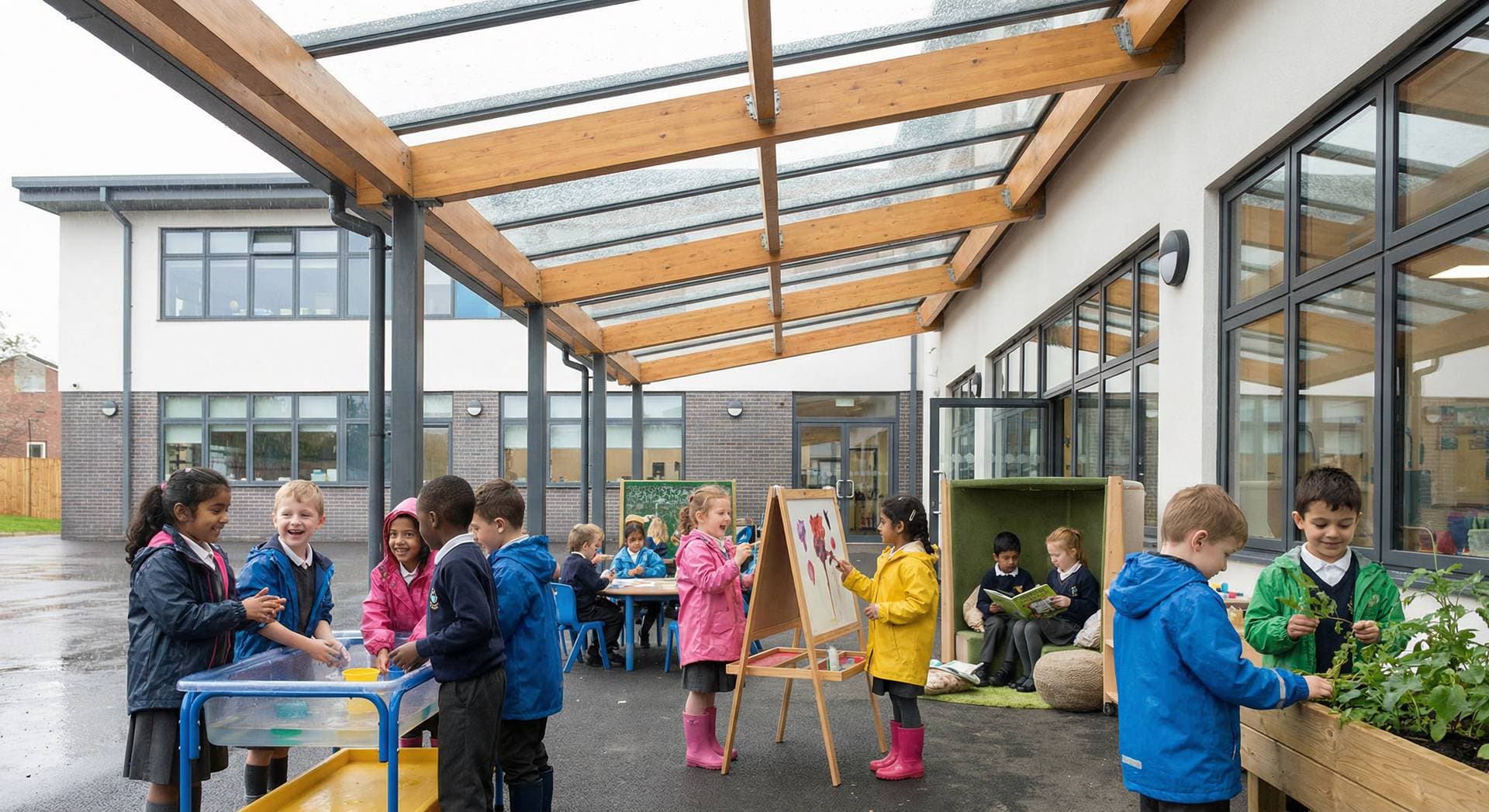
They create what I call "weather-flexible space." Not indoor, not outdoor, but something in between. Kids are outside, getting fresh air and daylight, but they're protected enough to actually focus on learning.
A primary school in Manchester told me they'd essentially written off outdoor learning between October and March before installing a covered walkway. Now they use it year-round.
Real Examples From Schools We've Worked With
I'm not big on made-up statistics, so let me share what actual schools have told us:
St. Mary's Primary, Lancashire: Before their covered walkway, outdoor lessons happened maybe twice a week in winter. After installation, they averaged four times a week. The teachers said it wasn't just about having cover - it was about knowing they could rely on the space whatever the weather.
Oakfield Academy, Yorkshire: They installed a covered walkway connecting two buildings. The unexpected benefit? Kids started using it for outdoor reading sessions. Their literacy coordinator said it became the most popular spot in school during independent reading time.
Greenhill Secondary, Bristol: Their covered outdoor area now hosts everything from art classes to drama rehearsals. The drama teacher was particularly enthusiastic - something about acoustics being better than the hall, apparently.
Why Covered Walkways Work (The Practical Stuff)
It's not magic. It's just good design meeting practical needs.
Weather Protection Without Being Indoors: Kids get natural daylight, fresh air, and a sense of being "outside" without getting soaked. That matters more than you might think - there's proper research showing daylight affects concentration and mood.
Flexible Teaching Space: A covered walkway isn't just for walking. With the right design, it becomes an extension of your teaching space. We've installed walkways that schools use for:
- Outdoor lessons in all subjects
- Forest school activities
- Group work and collaborative projects
- Break-time activities
- Parent pickup areas that actually work
Year-Round Usability: This is the big one. An outdoor space that's only useful in summer isn't really solving your problem. A covered area works in drizzle, light rain, even snow. The only time you can't use it is in proper horizontal rain, and let's be honest, everything stops in that weather anyway.
What Makes a Good School Covered Walkway?
I've got fairly strong opinions on what works and what doesn't for schools.
Height Matters: Too low and it feels claustrophobic. Too high and rain blows in. We typically recommend 2.7-3 metres for primary schools, slightly higher for secondary. It's a Goldilocks situation - needs to be just right.
Width Matters Too: A narrow covered walkway is just a corridor. You want width for activities. Minimum 3 metres, ideally 4-5 metres if you're planning to actually teach there.
Sides (Or Not): This depends on your site and prevailing wind direction. Some schools want completely open sides for maximum flexibility. Others need one closed side because the wind always comes from that direction. We assess each site individually.
Polycarbonate vs Glass: Both work. Polycarbonate is lighter and more flexible. Glass looks more premium and doesn't scratch as easily. For schools, I usually suggest polycarbonate with UV protection - it's practical and cost-effective.
Lighting: If you want to use the space during winter afternoons, you'll need lighting. LED strips integrated into the canopy structure work well - low running costs, good coverage.
The Curriculum Angle
Here's something interesting: schools are increasingly expected to deliver outdoor learning as part of the curriculum. Forest schools, outdoor education, wellbeing activities.
That's brilliant when the weather cooperates. Less brilliant when you're trying to schedule it around British weather.
Covered outdoor spaces give you the flexibility to actually plan this stuff. You can timetable outdoor lessons without having a backup plan B every single time.
One headteacher told me it changed their approach to curriculum planning. Instead of hoping for good weather, they now assume the covered space is available and plan accordingly.
The Cost Question
I know what you're thinking: "This sounds great, Alex, but what about the budget?"
Fair question. A decent covered walkway for a school typically ranges from £15,000 to £40,000 depending on size and specification.
That's not pocket change. But let's put it in perspective:
You're creating usable space that adds value year after year. If it genuinely increases usable outdoor time by 30%, that's significant. Schools spend money on things that have much shorter lifespans.
Plus, many schools fund this through:
- School Condition Allocations (SCA): direct capital funding for MATs and local authorities
- Finance leasing: since September 2024 schools can arrange this without Secretary of State approval
- Condition Improvement Fund (CIF): for standalone academies and smaller schools
- PTA fundraising (especially if you involve parents in the planning)
We've helped schools with funding applications. When you can demonstrate clear educational benefits and year-round usability, it's a much easier sell. For a full breakdown of every funding route available, see our complete guide: How Schools Fund a Covered Walkway: DfE Grants, SCA and All Your Options.
Getting Started
If you're thinking about adding covered outdoor space to your school, here's my practical advice:
Start with your needs: What do you actually want to do in this space? Teaching? Break-time activities? Weather-protected access? Be specific.
Look at your site: Where would it actually go? What's the prevailing wind direction? Where do kids naturally congregate?
Involve your staff: Teachers know what would actually be useful. Ask them before you commit to a design.
Think about the future: You're making a 15-20 year decision. Will this still work as your school evolves?
Serving Schools Across the UK
We've installed covered walkways and school canopies at schools throughout the UK. You can see some of them in our case studies.
Whether you're an inner-city primary or a rural secondary, we can design a solution that works for your site and budget. View all areas we serve.
Final Thoughts
British weather isn't changing anytime soon (well, it's getting wetter if anything). Your outdoor space shouldn't sit unused for half the year just because of drizzle.
Covered walkways aren't a luxury - they're a practical solution to a very British problem. Done right, they become one of the most-used spaces in your school.
If you'd like to discuss what might work for your school specifically, give us a ring on 01704 547 321. Happy to have a chat about your site and what would actually make sense for you.
No obligation, no hard sell. Just practical advice from someone who specifies and installs these for schools.
Managing Director, Alotek Shelters Ltd
About Alex Thomas
Managing Director of Alotek Shelters since 2021. Trained in CAD and design at Southampton Solent University (BSc, 2:1). Design, fabricate and install from the Lancashire workshop.